Author: Elise Kindya

  • How I Manifested Facilitating a Retreat in Less Than 5 Hours!

    How I Manifested Facilitating a Retreat in Less Than 5 Hours!

    In this solo episode of Returning Home, hear about how I manifested facilitating a retreat in less than 5 hours!

    And it’s NOT what you think…

    The term “manifesting” is all the rage right now, and I believe we are manifesting all the time. Whatever you have in your life currently, you “manifested” it, whether intentionally or not. Our words are spells that we use to speak our life into being. With enough belief, our thoughts become things. It has to feel true to you, right? (This isn’t a statement about big social issues like racism, sexism or homophobia, but about circumstances that we choose to live in).

    I love to pull intentionality into the practice of manifesting because then I know I am consciously choosing what’s showing up in my life.

    Listen to this episode to hear all about:

    1. How I manifested facilitating a retreat for a staff of therapists in less than 5 hours!
    2. My process for getting to the point I am at now in my career and my mindset.
    3. What I think is the key piece to living the life you desire.

    Resources:

    Transcript:

    Elise Kindya

    00:00:04.20

    I think that’s really like the take away from this too is sure like, and it sounds flashy to be like how I manifested facilitating a retreat within like literally five hours of stating that’s what I wanted.

    00:00:19.16

    But like I said at the beginning of this story is that it starts way earlier.

    00:00:25.08

    It started with planting seeds a long, long time ago and the day that you plant the seed is not the day that you’re going to eat the fruit.

    00:00:32.36

    Like this is something that I’ve been working for and I will continue to work for.

    00:00:40.56

    Welcome to Returning Home, the podcast.

    00:00:43.56

    My name is Elise Kindya and I am a trauma informed and intuitive therapist.

    00:00:49.00

    This podcast is a space that I have created for you to discover a deeper understanding and love for yourself, which leads to expanding what you think is possible in your own life.

    00:01:00.84

    My goal is for you to feel excited to live your life as your full, authentic self.

    00:01:06.60

    By listening to these episodes, you will learn things like how your brain works, my favorite resources for healing, stories from my own life, practices that you can press play on to add to your healing toolkit, and so much more.

    00:01:21.60

    I invite you to return home to yourself in big and small ways to live the life you desire on your terms.

    00:01:28.80

    You can live connected, empowered, and aligned.

    00:01:32.16

    When you return home to yourself, anything is possible.

    00:01:36.08

    I can’t wait to share all of my insights with you.

    00:01:39.04

    Now let’s begin.

    00:01:46.26

    Hey guys, you’re invited to my upcoming Sound bath series at Living Water Community Center.

    00:01:52.54

    These sound baths are donation based and they take place on Sunday nights at 6:30 at Living Water Community Center in the South side of Richmond which is at 1000 Westover Hills Blvd.

    00:02:04.88

    Richmond, VA 23225.

    00:02:08.16

    And at these events you can expect to have a sound bath with singing bowls and chimes that are going to help you relax.

    00:02:17.16

    Let go of the weekend.

    00:02:18.68

    Start your week without the Sunday scary’s.

    00:02:21.88

    So you’re going to want to bring a yoga mat, blanket, eye mask, and anything you need to feel comfortable and relaxed.

    00:02:28.88

    The next time that I’m going to be at Living Water for a sound bath is on Sunday, July 7th at 6:30 PM and my dates following up from that are July, July 14th and August 11th.

    00:02:43.84

    So I hope to see you at any of those sound baths at Living Water Community Center.

    00:02:50.64

    And thank you so much for tuning in.

    00:02:54.64

    Hey, and welcome back to Returning Home, the podcast.

    00:02:58.52

    I’m your host, Elise Kindia, and today I want to talk to you and share a story with you about how I got something really cool to happen in my life.

    00:03:10.16

    The first thing to keep in mind about anything that you see, you know, people talking about something that they got in their life is knowing that this didn’t happen overnight.

    00:03:21.64

    Like, you know, I, I don’t know if you’ve heard the saying that every overnight success is 10 years in the making.

    00:03:28.48

    And this is kind of a similar.

    00:03:30.68

    I want you to have that phrase in mind as I tell this story because the way that it all unfolded was it felt really fast.

    00:03:39.72

    But if we really think about back to like the root of how this even came about is like years and years and years in the making, you know, going back all the way to when I decided to go to grad school.

    00:03:53.80

    So and that was in 2009 is when I started that process, right?

    00:03:58.76

    So, but deciding that I wanted this thing to happen and then it happening did happen within like one day.

    00:04:07.60

    So it was really interesting and I think it’s something to keep in mind.

    00:04:11.60

    And I just think it’s so cool that I wanted to share it.

    00:04:14.08

    I had posted a story in my Instagram about how people wanted this story time and most people said they wanted a podcast episode.

    00:04:24.04

    So I am here sharing that.

    00:04:25.76

    Now some people said Instagram stories only and that is also kind of my vibe, but I really did.

    00:04:34.52

    I felt like this deserved a little bit more of a long form story because yeah, it’s a little bit the the Instagram story format, I think is a little bit too condensed.

    00:04:47.44

    So without further ado, let me get into this story.

    00:04:52.36

    So I’d say, I mean, even when when I think back about why did I become a therapist, of course, it’s to hold space for people to create transformational experience, experiences for people where they can kind of access their own power, where they can see their value and that things that they’ve been through.

    00:05:17.96

    Sure, we didn’t ask for them to happen, but they did happen.

    00:05:22.20

    And so now what are we going to do going forward, Right.

    00:05:26.16

    And so, yeah, having always had a intention or purpose for my work, but that continuously evolves.

    00:05:40.00

    If you’re new here, a little bit more of my, like, boring back story, so to say, is I was really burned out at work.

    00:05:48.00

    I started working professionally as a social worker in 2013 after I graduated from Graduate School and, you know, working in the field from 2013 until 2018.

    00:06:03.60

    I was just getting extremely tired, burned out, feeling kind of hopeless about my work, feeling like my work didn’t have any purpose, feeling like I wasn’t seeing any output.

    00:06:17.04

    And that was really difficult for me.

    00:06:19.36

    I’m somebody that I want to see the progress.

    00:06:21.96

    I want to see what’s going well.

    00:06:24.36

    I want to, you know, do the pre test and the post test and see like this is making an impact and you want to just like help people feel better is the whole point.

    00:06:35.00

    And I just was reaching kind of the end of my rope at that point.

    00:06:38.36

    I, you know, was working with kids and that population can be very difficult, especially working with kids who are experiencing trauma.

    00:06:47.68

    And you know, you do some work with them, but then they go back out into their environment that is just re traumatizing them.

    00:06:55.76

    And it feels like it’s so hard to see progress.

    00:06:59.20

    So I had to take a step away from my work in 2018 where I just left my career and decided to get some part time jobs.

    00:07:10.04

    And one of those was at a float spa where I met a lot of really cool people who were doing more, I guess, alternative methods of healing that.

    00:07:22.24

    I mean, I’ve been practicing yoga since 2006 maybe.

    00:07:28.68

    Like I was aware of all these things.

    00:07:30.40

    And even in my work as a social worker that I had just stepped away from, I was doing mindfulness and meditation and things like that.

    00:07:39.28

    But there were some other modalities that I was familiar with but not intimately familiar with.

    00:07:44.56

    Like Reiki massage was always something that I was interested in.

    00:07:49.60

    But, you know, became more intimately aware of that in my new position at this spa.

    00:07:56.64

    And then as well flotation, like sensory deprivation and, you know, the power of using your your brain and the different states that you can get into, like the Theta state to do some healing on a more cellular level.

    00:08:18.64

    But yeah, so from there is where I heard about Reiki and decided to get trained in that, got really interested in that.

    00:08:25.96

    And from there just kind of progressed into the world of more holistic healing and more well-rounded healing approaches, not just mental health, which I had been doing mostly since, you know, 2010.

    00:08:41.36

    And it was a really amazing kind of unfolding of all of these practices and modalities that I started to delve into.

    00:08:54.08

    And over the last few years, you know, I became really interested in sound baths and I would attend a lot of sound baths.

    00:09:02.88

    I would Co facilitate sound baths where one person was playing the balls and then I would lead a guided visualization.

    00:09:15.04

    But I just really loved music.

    00:09:17.60

    For my whole life I’ve been really into music.

    00:09:20.48

    I can like name any tune, actually.

    00:09:22.96

    Funny side note, during quarantine, like the very beginning of COVID, my husband used to play these like popular songs, but they were played on like, I don’t even know, like in a different font, so to say, like in a different style, almost like lullaby versions of popular songs.

    00:09:45.72

    And then I would guess what the song was.

    00:09:48.80

    And just as some like, I can do that.

    00:09:51.36

    I have a musical ear.

    00:09:53.04

    And he was always so impressed by that.

    00:09:54.92

    And I just, I love that he was impressed by that.

    00:09:57.32

    I take it for granted that I can do things like that.

    00:09:59.96

    My introduction to sound healing began in probably 2018-2019 is when I started going to sound baths and then, and I had already gotten trained in Reiki at that point in 2019.

    00:10:20.16

    And then finally in 2023, I actually bought my own bowls.

    00:10:27.96

    I, that wasn’t something that I had planned on doing, but you know, just with COVID and quarantine and things becoming so accessible, it actually was feasible for me to buy my own set of bowls.

    00:10:41.52

    So I did that recently and added those onto my in person Reiki sessions as I can add on or the way that we would end our sessions.

    00:10:54.20

    And I really loved that because I was trained in holding space in this way of like the verbal and the, you know, holding space, talking with people and either guiding a meditation or holding space in a talk therapy session.

    00:11:10.16

    And as much as I love that, sometimes it’s nice to do something a little different and step outside your comfort zone, right?

    00:11:18.28

    So I found that I really enjoyed leading sound baths because I can still hold space for people, but I can almost get into a flow state.

    00:11:30.88

    And there’s a book about this that I’ll link in the show notes about getting into flow States and how, you know, this is really good for our brain, our brain waves, our brain chemistry, our use of energy because we’re just constantly like revving all this energy up in our brain.

    00:11:48.24

    And it’s nice to be able to do something that feels really productive, but also doesn’t require all this over use of the brain.

    00:11:59.16

    And I found that it was really healing for me too.

    00:12:03.04

    Like it’s a both and I’m holding space for healing other people while also being able to receive that from myself and like from the experience of the group.

    00:12:14.04

    And I just find that so powerful.

    00:12:17.32

    So and then last year in April, I started renting my office right?

    00:12:24.28

    So now all the pieces of the puzzle were coming together.

    00:12:28.36

    I had my Reiki training.

    00:12:30.88

    I’m able to, since I have the master level, I can train people in that.

    00:12:35.56

    I have my own space where I can hold, you know, one-on-one sessions as well as group sessions and trainings.

    00:12:43.56

    And then I got my singing bowls and all of those pieces just really started to coalesce together into something, you know, these things kind of evolve without a plan necessarily.

    00:12:55.56

    Like we have the ideas and like I, I talk about this a lot of following the breadcrumb trail of life, like just go where your excitement and where your inspiration takes you.

    00:13:08.72

    And that’s what I do.

    00:13:09.72

    That’s like kind of how I live my life just in general.

    00:13:15.08

    And so in February I started February of 2024, I had my first in person Reiki one and two training to train people in this healing modality.

    00:13:28.92

    And one of my students is also a sound healer and went to a sound healing training with a well known person here in Richmond and just expressed interest like she she a few times like expressed interest in wanting to do things together.

    00:13:46.68

    And I said yes, like I just was so into this idea of having a person who we both do Reiki and we both do sound healing and we can hold this space together.

    00:13:59.12

    And so I, her and I have been saying yes to each other a lot and holding space together.

    00:14:05.16

    And it’s felt so good to partner with someone to, you know, feel like there’s more going on than just me.

    00:14:16.88

    That is something that has been hard for me is, you know, having like pressure on my shoulders or feeling like, oh, I have to do everything myself.

    00:14:25.92

    I have to make all this stuff happen.

    00:14:28.00

    And so for somebody to kind of step up and be like, hey, I want to do this with you has felt so exciting because I do, I mean, I have a lot of energy.

    00:14:37.20

    I want to be doing all these things.

    00:14:39.48

    But sometimes it’s just a matter of like, there isn’t enough time and like I don’t always have the energy to do every detail of everything.

    00:14:47.36

    So I felt really, really excited.

    00:14:51.04

    And my student’s name is Shanice that she wanted to do these things with me.

    00:14:56.32

    So over the last few months, I would say since March or April, we’ve been hosting events around the city where we set up in a park or at my house and we play singing bowls together and we offer hands on Reiki together.

    00:15:17.88

    And, you know, marketing is always a hard thing, I think, well, maybe not always for everybody, but for me and in my, the way that I think and just, you know, what I do all the time, it’s kind of a challenge.

    00:15:34.68

    And I was thinking about different ways that I could get the word out about our events.

    00:15:39.08

    And finally I just kind of caved.

    00:15:41.96

    You know, I, I know Facebook has been kind of on the outs with a lot of millennials.

    00:15:47.64

    And that was kind of my thought about it for so long.

    00:15:49.72

    I’m like, oh, nobody’s on Facebook.

    00:15:51.64

    Like, why would I post on Facebook?

    00:15:53.52

    But I thought, you know, I already have a Facebook account, like I can just make an event.

    00:15:58.76

    It’s not that big of a deal, like it’ll be good.

    00:16:00.84

    And then I can invite my whole friend list and like post it on different groups and things like that.

    00:16:06.00

    So I went ahead on Facebook and I made an event for one of our sound baths and hands on Reiki events that we were going to be doing.

    00:16:20.24

    And, you know, just made that event.

    00:16:25.88

    And then I, I think it was in this order where one morning I just thought I was, you know, sitting at my altar.

    00:16:33.52

    I was meditating and I pulled out my journal and I was just journaling about how I wanted to be asked to facilitate retreats.

    00:16:44.32

    This is something that’s been on my, you know, desires list professionally for a long time.

    00:16:51.04

    I’ve tried to put together retreats before, like last New Year’s, I rented an Airbnb and, you know, put together this retreat.

    00:17:01.32

    And I’ve had some interest, but ultimately, you know, nobody came, so I had to cancel it.

    00:17:06.04

    And there’s been a few other kind of things in the works that just hadn’t panned out, which is OK.

    00:17:14.20

    That’s just life.

    00:17:15.04

    And you know, kind of Fast forward to right now, it’s June of 2024 and I have some things like in the works, which I am excited to talk about.

    00:17:24.28

    But I had that morning and it was sometime in May of 2024, I was sitting and writing in my journal about how I wanted to be asked to Co facilitate a retreat.

    00:17:37.72

    And you know, my, my vision for that is something to travel.

    00:17:43.28

    Like I want to go to a beautiful place and have beautiful catered food and like other facilitators doing their workshops and me doing my workshops and just having like a beautiful, lovely time together, just holding space for the participants and each other and, you know, putting healing at the forefront of our intention.

    00:18:07.60

    That is still my vision and would still love for that to come to fruition.

    00:18:13.20

    But so I did write about that in my journal and then I went to work and got on my computer and started sharing the event for Shanice and I’s Reiki and Sound Bath event on different Facebook groups.

    00:18:31.56

    So one of the Facebook groups that I shared it to was for therapists in private practice because I thought, oh, who better than to receive a healing experience like this than a therapist, right?

    00:18:45.80

    Of course, I always have that at the front of my mind.

    00:18:50.56

    And so I shared it there saying, hey, come take really good care of yourself at this event and the link to the event and really didn’t think anything of it.

    00:18:59.76

    You know, just hoping that that generated some interest that people would want to come to something like that and posted it in a few other events and just kind of like went about my day.

    00:19:11.76

    I saw clients, stuff like that.

    00:19:14.36

    Then I come to my phone, I believe, or maybe I went back on Facebook to see the comments and stuff and there was a comment from somebody in the private practice therapists group saying, Hey, I need help with a retreat that I’m having for my staff.

    00:19:37.84

    Would love to connect.

    00:19:38.84

    And so I ended up connecting with this business owner and it turns out that everything that she needed for this retreat for her staff was like exactly in my wheelhouse.

    00:19:51.60

    And I’ve been saying this on my Instagram lately where I’m like, I’m not a black sheep.

    00:19:55.12

    I’m a Unicorn.

    00:19:56.08

    Like I I just everything that Ioffer was exactly what she was looking for.

    00:20:00.96

    So she wanted breath work.

    00:20:04.08

    Well, I’m a breath work teacher.

    00:20:05.44

    She wanted.

    00:20:06.76

    You know, meditation, visualization type stuff.

    00:20:09.64

    That’s exactly what I do.

    00:20:11.16

    I used to have a online course called Slow Down to Speed Up and it was a visualization master class.

    00:20:16.80

    She wanted training on polyvagal theory and trauma and vicarious trauma and recognizing burnout and avoiding burnout and healing from burnout.

    00:20:27.24

    And I was like, Oh my gosh, like that is I had just bought 5 books and a card deck on polyvagal theory and have healed myself from burnout through, you know, the story I just kind of told earlier in this podcast episode, you know, stepping away from my work and finding what actually lights me up about my work.

    00:20:51.92

    But I was so burned out and came back on the other side like so much stronger.

    00:20:57.00

    So our conversation was just like really hitting.

    00:21:00.00

    It was like, Oh my God, like everything that I do.

    00:21:02.84

    Oh, and then she also wanted a sound bath for her staff, right?

    00:21:05.48

    Which is what I even posted in the group about.

    00:21:09.56

    And I just felt like everything was so aligned.

    00:21:12.12

    I was like, whoa, you know.

    00:21:14.92

    And so I just thought it was so interesting that that very morning I had written in my journal, I want to be asked to facilitate retreats.

    00:21:24.88

    And then I just kind of let go of the expectation or the process or figuring out how that was going to happen.

    00:21:33.72

    I had, I did not know this woman previously.

    00:21:36.72

    Like I had no contacts.

    00:21:38.28

    I had no, there was no insider information that I had on this.

    00:21:44.88

    Like I just simply said what I wanted, wrote it in my journal, then had already made the Facebook event, you know, went and posted it in a few places.

    00:21:55.76

    And then this invitation came in that same exact day.

    00:21:59.60

    And it just felt like such a confirmation.

    00:22:02.68

    It felt so aligned, so purposeful.

    00:22:08.88

    It was so on purpose in a way that I couldn’t have planned or I couldn’t have written it this way, right?

    00:22:19.76

    Like there’s no, these things just happen and they’re so cool.

    00:22:25.68

    And so, and we just had the retreat this past Monday, today’s Wednesday.

    00:22:33.16

    And it was amazing.

    00:22:34.04

    Like it was such a cool space.

    00:22:35.76

    We were at Pocahontas State Park in one of their buildings that you can rent that I, I didn’t even know that stuff was there.

    00:22:43.32

    And I, it was a beautiful room.

    00:22:45.76

    It was a beautiful space.

    00:22:48.44

    All the food was taken care of.

    00:22:50.08

    Like, you know, that I didn’t have to do anything but show up with my materials.

    00:22:56.00

    I had to prepare, of course, a presentation and decide what I was going to do.

    00:22:59.88

    But I just had to show up and be myself and facilitate in a way that made me excited.

    00:23:09.48

    And my husband always likes to, you know, say how I like to go above and beyond for things And I did.

    00:23:16.36

    I definitely made like a very nice print out.

    00:23:19.28

    You know, I brought all these resources and books.

    00:23:22.68

    Yeah, I I did put a lot into that.

    00:23:25.84

    But I think sometimes the energy that we put into things is what we get out of it, right.

    00:23:30.04

    So I think that’s really like the take away from this too is sure, like, and it sounds flashy to be like how I manifested facilitating a retreat within like literally five hours of stating that’s what I wanted.

    00:23:46.04

    But like I said at the beginning of this story is that it starts way earlier.

    00:23:52.00

    It started with planting seeds a long, long time ago.

    00:23:54.76

    And the day that you plant the seed is not the day that you’re going to eat the fruit.

    00:23:59.20

    Like this is something that I’ve been working for and I will continue to work for.

    00:24:04.12

    But it’s funny how that day I sat down, wrote in my journal, was very clear about what I wanted to bring into my life, and then not a few hours later, I was bringing it into my life.

    00:24:17.64

    And so I think the moral of the story here is to never stop believing in yourself or stop believing in your dreams.

    00:24:26.76

    You can do all the things that you see yourself doing.

    00:24:31.32

    And that This is why I love visualization is like having a really clear goal in mind and being able to really flesh it out and see yourself there is really powerful.

    00:24:42.52

    It feels really good to see your dreams coming true.

    00:24:45.92

    I mean, duh, like understatement of the century, but knowing that you’re the one that that thought of that goal, that dreamed that dream that put the things into motion so that the things can start happening for you.

    00:25:04.68

    Of course, we need to, like, be out in the world, playing with other people, putting ourselves out there, making the Facebook event, sending the newsletter, making the social media posts and all that stuff, spreading the word, word of mouth, making Flyers, hanging them up, you know, talking about your stuff, talking about your work, getting excited and turned on by yourself and by your work and like what it is that you have to contribute.

    00:25:30.88

    All of that needs to be happening too.

    00:25:32.72

    Like it’s not just that I was sitting in my house and out of nowhere had the thought I want to do a retreat, wrote it in my journal and then didn’t do anything.

    00:25:41.52

    And then it came into my lap.

    00:25:43.20

    No, there’s other work that needs to happen, but go do the work like the that work that setting it all up and, you know, getting energetically ready for it.

    00:25:56.76

    That’s all part of the process.

    00:25:59.48

    And it can be really fun.

    00:26:01.04

    And it’s, it can be a whole story that you can tell, right?

    00:26:05.96

    I love telling people this story because it gets me really excited.

    00:26:10.20

    I don’t know if you can hear in my voice, but like, I’m smiling as I’m telling this story.

    00:26:15.24

    And what’s better than that?

    00:26:18.80

    Like, what’s better than being really excited and ready for your life?

    00:26:27.96

    What’s better than wanting to be the person that you are, wanting to be the person you wake up as?

    00:26:34.52

    I don’t know.

    00:26:35.92

    I think I was about to say, I don’t know that there’s anything better than that.

    00:26:42.44

    I see a lot of people in my work that, yeah, they just want to change so many things about themselves.

    00:26:48.08

    And it’s like, bro, like what if you just stopped and you decided I’m so great the way that I am.

    00:26:56.16

    I really like these things about myself and I’m not going to give myself such a hard time about this that the other thing, nitpick and all this, like everybody has flaws.

    00:27:08.36

    Everybody has stuff they could work on.

    00:27:10.36

    And that’s the cool thing about life too, is like you’re a project that you never have to stop working on.

    00:27:15.36

    There’s always going to be something interesting and cool and new that you can do, whether it’s with your mental health, your physical health, your spiritual health, your, you know, your community that you’re involved in, your friends, your family.

    00:27:29.52

    There’s always going to be a social issue to work on.

    00:27:31.88

    There’s always going to be, you know, there’s just, there’s always so much to do.

    00:27:36.36

    It’s not that you become stagnant and like complacent, but you decide that you love that who you are and you want to show up as that person.

    00:27:46.80

    And that, I think, is actual true freedom, not to mention, you know, 3D freedoms, of course, but I mean mental freedom and that liberation that we’re all looking for from maybe like an inner critic or the judgment that we’re afraid we’re going to face when we go out in the world.

    00:28:14.56

    If you’ve got your own back, if you have a strong core, if you’re somebody that you know yourself and you love yourself, then the judgement doesn’t really matter.

    00:28:23.56

    Like we kind of accept that we’re going to be judged.

    00:28:26.84

    It’s just an inevitable fact of life and we don’t let that hold us back or stop us from going for it and for living our truth.

    00:28:39.28

    So that is what helped me manifest this retreat within a few hours of saying that I wanted, it was all of this inner work that I’ve been doing for years and years and years.

    00:28:53.24

    And then I started putting it out there to my Instagram that I want to start doing more retreats and I want to hire somebody to help me, you know, with some things in my business that frankly just take a lot of time and I still want to do them.

    00:29:09.84

    I just, there’s only one of me and I can’t do every single thing.

    00:29:13.96

    And I’ve gotten a lot of interesting feedback and response to that.

    00:29:18.80

    And so, you know, there might be more retreats coming up for me from me to you.

    00:29:24.48

    Hopefully you want to come to them in this next year.

    00:29:28.52

    And, you know, people to help me with some of this kind of work, like this podcast.

    00:29:34.60

    Of course, I’m just sitting here kind of pressing play on my computer, but I need people to help me on the back end of that.

    00:29:40.04

    And so just asking for the help I need.

    00:29:43.12

    And I’m sure that resonates for any of you.

    00:29:44.68

    Like, I mean, I hear about this all the time.

    00:29:46.32

    It’s so scary and hard to ask for help.

    00:29:48.88

    But the only way that we really make anything happen in our lives is by getting out there and playing with other people.

    00:29:57.84

    So I just want to leave you with that, that it’s important to know who you are and how you want to show up.

    00:30:09.52

    You don’t have to get it perfect every single time.

    00:30:12.56

    I know that I have definitely, and I don’t want to say failed, but things haven’t gone necessarily quote UN quote according to plan, but I still get out there and show up because I know who and how I want to be in the world.

    00:30:28.08

    And I can’t let anything really stop me from that.

    00:30:31.92

    And so I just want to offer that to you.

    00:30:34.28

    I’m sure there are other obstacles that you have to deal with and face, and I want to encourage you to not let them put you at a full stop.

    00:30:43.88

    Maybe sometimes you have to pause and look at that obstacle and decide how you’re going to work with it or get over it or move through it.

    00:30:52.48

    And that’s totally valid.

    00:30:54.36

    And taking the time to do that is important.

    00:30:57.04

    But you have to take the time to do that and then take the action through the obstacle because the world needs whatever it is that you’re trying to put out there, like we need it.

    00:31:06.64

    And so I just want to encourage you to keep going to keep showing up for your dreams to be the dreamer of your dream and feel really not that you can be like confident 100% of the time, but like feel confident, like be feel like that’s a worthy thing for you to do because it is even if it’s something small, it doesn’t really matter.

    00:31:33.00

    Like if it makes you happy, if you’re smiling when you talk about it, that’s important.

    00:31:38.04

    So I just want to encourage you to get out there, go after it.

    00:31:42.48

    I hope to be back on here telling you more stories about things that I manifested very quickly.

    00:31:50.16

    But yeah, and to for you to stay updated and stay tuned to when I’m going to offer more retreats.

    00:31:59.00

    Go ahead and sign up for my newsletter or follow me on Instagram so that you can stay updated on that.

    00:32:04.56

    And I wish you a beautiful day and I’ll talk to you soon.

    00:32:08.20

    Bye.

    00:32:09.68

    Thank you so much for listening to today’s episode.

    00:32:12.76

    I hope that you learned a lot.

    00:32:14.20

    I hope that you got inspired.

    00:32:16.48

    And if you enjoyed what you heard, please go ahead to Apple Podcasts and leave a review.

    00:32:22.76

    Rate US five stars.

    00:32:24.36

    All of that goes a really long way.

    00:32:26.52

    So thank you so much for listening, and we’ll look forward to seeing you on the next episode.

    00:32:30.80

    Bye.

    Powered by TranscribeKit
  • Being Human With Other Humans: A Conversation With Brittany Deutch, LPC, ATR-BC

    Being Human With Other Humans: A Conversation With Brittany Deutch, LPC, ATR-BC

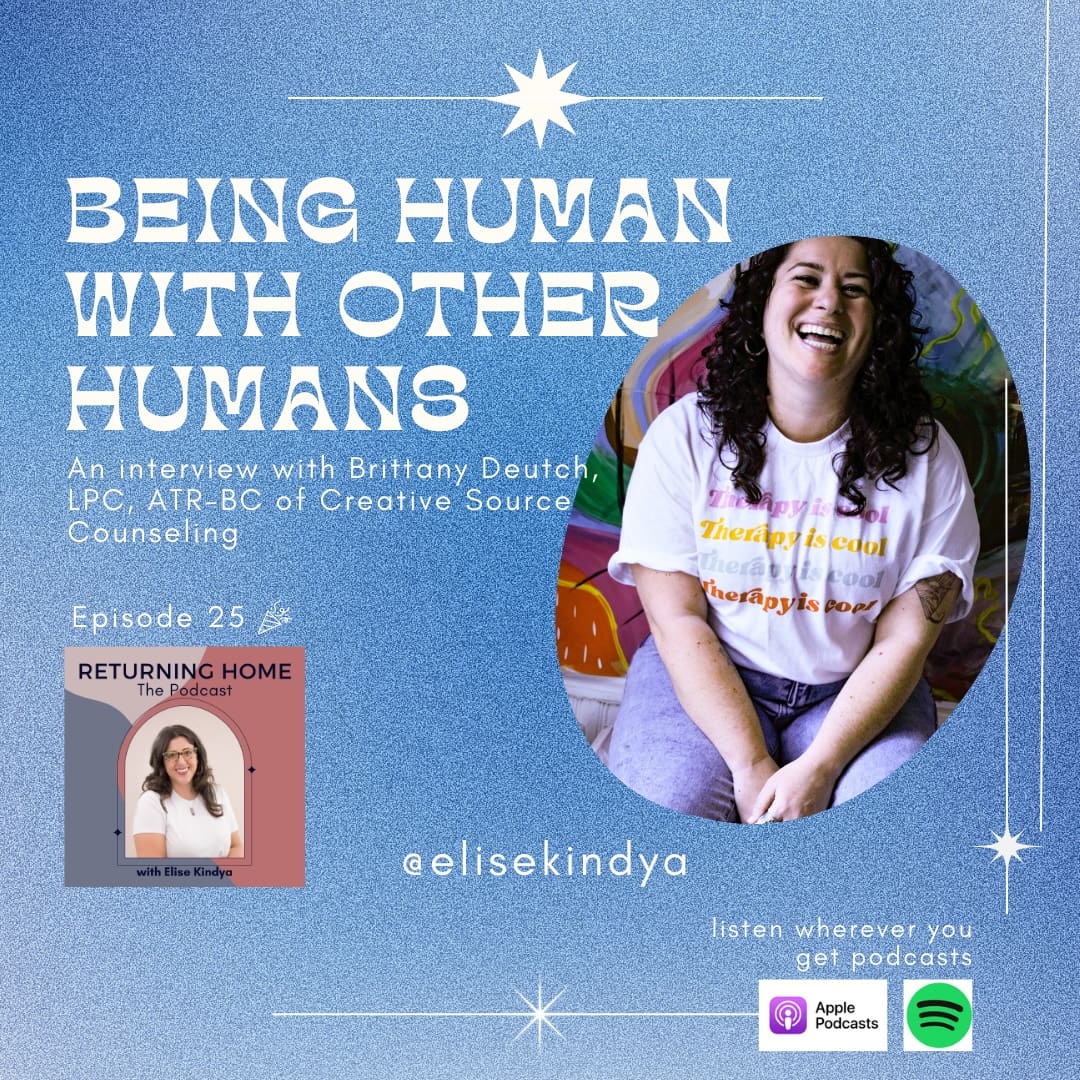
    Get ready to meet Brittany Deutch, LPC, ATR-BC of Creative Source Counseling. On episode 25 of Returning Home: The Podcast, we talk all about Brittany’s work and 10 years of experience in the mental health field, as well as her exciting international travels as a private practice therapist! Brittany is a licensed professional counselor and board-certified art therapist committed to helping women and LGBTQ+ folks navigate the complexities of family, career, and personal identity, and work towards achieving a more balanced and fulfilling life. She is passionate about walking alongside people who are learning to trust themselves, live out loud and take up space in the world. While listening to this episode, you might laugh, you might cry, you might feel really really seen! Please enjoy our conversation and let us know what you think in the comments!

    Here are three reasons why you should listen to this episode:

    1. Hear from Brittany about how she envisions art therapy to help her clients through difficult times.
    2. Learn what types of art materials Brittany’s clients sometimes use (it might not be what you think!).
    3. Discover how art therapy complements any course of therapy treatment.

    Resources

    • Listen to previous episodes of Returning Home:
      • Episode 22 | How To Follow Your Highest Excitement with Jenny McGurk
    • Connect with Elise on Instagram: @portal.therapy
    • Brittany Deutch’s website: https://www.creativesourcecounseling.com/
    • Connect with Brittany on Instagram: @brittanydeutch
    • Check out my 2nd Sundays Soundbath series at Living Water Community Center by clicking here.
    • Attend my upcoming Soundbath and Reiki event on June 15th at Dogwood Dell! More info here.

    Enjoyed this Episode?

    If you enjoyed this podcast, please make sure to subscribe and share it!

    Leave an episode review and share it! If you enjoyed tuning in to this episode, don’t forget to leave us a review. You can also share what you’ve learned today with your friends to help them embody their true, authentic selves. Anything is possible when you return home to yourself. 

    Have any questions or lightbulb moments? I’d love to hear from you! Feel free to hit me up on Instagram or send an email at elise@elisekindya.com. 

    Thank you so much for listening! For more episode updates, visit my website.

    Transcript

    This editable transcript was computer generated and might contain errors. People can also change the text after it was created.

    Elise Kindya: Welcome back to Returning Home: The Podcast. This is Elise Kindya your host and I have my guest here today Brittany Deutch who is a therapist. She’s just going into private practice recently, and we have just been talking and now we need to record because we have so much to say so we’re not going to do too much of an instrument, but I’m gonna edit this too Nicene gotta just brain it in Elise. okay.

    Elise Kindya: So yeah, Brittany Deutch is my guest and yeah, why don’t you just tell our listeners a little bit about 

    Brittany Deutch: Hi everybody. I’m really excited to be here and be chatting with you all. So yeah as Elise mentioned, I just started a private practice. I’ve been in the mental health field for about 10 years now, which is wild to even think about but I’m an art therapist and usually I work with women and queer folks who just kind of really get stuck in the shoulds the overwhelm and are trying to Figure out what is no longer working for them so that they can decide what is going to work for them. And that’s where a lot of my clients are kind of feeling stuck right now, but I’m excited for this new journey and yeah. Yeah.

    Elise Kindya: so like you just said so something that I heard a while ago that helped me kind of move forward in my own career was you’re always helping someone that’s one step behind you and at the time I was working with children.

    Elise Kindya: I mean and their parents are there, but absolutely I’m not one step ahead of a child. that’s not a thing so that helped me kind of make a pivot in my own life. and you were just saying about your clients and how people do feel stuck and that’s the passion that you have the work that you like to do. So it sounds like and when you just introduce yourself around being in the mental health field for 10 years and now you’re in private practice. What was that? Journey of getting unstuck maybe because now you’re unstuck and you’re helping people who are stuck. Yeah. Yeah. What’s that Journey been like for you? 

    Brittany Deutch: Yeah, so it’s been quite the journey, I would say. so I got my undergrad in I’m gonna I’m gonna go like yeah, I got my undergrad in social work and my kind of main population that I was working with was unhoused th. So 18 to 24. I loved that work. It was amazing. It was incredible and after undergrad I worked there for a little bit and that was actually when I was introduced to Art therapy. I never heard of it before and there was an intern that was working at the shelter that I was at. And started doing art therapy and a lot of the clients who had been forced to see therapists or what they just would see there because They wouldn’t say a word would go to this art therapist and actually start opening up and I was like, whoa, what is happening? And I have been an artist or just engaged in art throughout my entire life. And I remember having conversation with one of those clients there and they’re like miss, I am not as angry when I’m painting and I was like what is happening? Because I had a lot of anger and so kind of shifting into that. I started looking into art therapy and seeing just what this entire field was, which was really amazing and then went to grad school for art therapy worked again with children who had experience trauma sexual abuse. I worked in a partial hospitalization  and intensive outpatient for substance use I’ve worked in a inpatient psych hospital and residential facility. So I’ve done so many different things worked with a lot of different populations, which has been incredible and I feel like I’ve learned so much and part of the thing that I love as a therapist is just like being human with another human. I feel like that’s so much of how I am and how I work and I feel like I’ve been able to experience being a human with so many different people with so many different experiences and so now going from and then I was in a group practice after and that was really when I started being able to do more of the outpatient work and what’s interesting is yeah, all of those different people are presenting with a different type of Trauma of Crisis different type of thing that’s coming up in their life. But again when we break it down, we all want something similar. We want to feel safe. We want to heard we want to feel seen and so I think that now working with people who feel really stuck and it is like, how do I do this next best thing and so Do you ask how has that helped in my life? And I just feel like I just kept asking myself. What is the next right thing for me? and that looks different what I thought I was gonna do 10 years ago looks different than what it is that I’m doing now and who knows what will happen 10 years after that but as long as I can say what is an x-ray thing for me right now and I think those part of why I started this practice and when I was talking to other clients that I had about transitioning, I said to them I talk to you every day about creating life that you actually want to live. And I thought it’s my turn thanks to do that and to really kind of look at what that is and what I want and so here I am starting the practice and we’ll see where that ends up. That’s what Yeah. 


    Elise Kindya: So your practice is called Creative Source counseling but that mean 

    Brittany Deutch:connecting with kind of your inner Creative Source. So as we said, I’m an art therapist and also a license professional counselor, and not all of my sessions involve artwork. It’s very much client Led if they want to do art or not do art. but one of the things that I love about the art is you’re able to connect with that inner Source able to connect with that inner knowing a lot of times I’ll do an art intervention with somebody and we’ll talk about it. We’re processing it and my response is always like this came from you. I didn’t give you those words. I didn’t tell you what to do this came from you and so connecting with that Creative Source letting that Creative Energy kind of flow through you connect through you come out of you to be able to see what’s actually happening internally. Yeah.


    Elise Kindya: So in your sessions with people are you painting are there easels are there canvases? what is an art therapy intervention or what does that look like for the client?

    Brittany Deutch:  And so it’s really different based on the client based on what we are working on. So a lot of my clients when they first come in they’re I’m open but I don’t know. I’ve never really done this art therapy thing or some people have been like I talk therapy just wasn’t really working for me anymore, and I wanted to see something different and so something different. Sometimes that looks like I hold on. Let me rewind a little bit right now. My practice is virtual.if I’m in person then I provide the art materials, but if we’re doing virtual sessions, then it is often. Okay. What do you have around your house? we don’t need anything fancy. Yeah, some people they do have the paints and the easels and all of that. some people just crayons some people it’s highlighters, I encourage color in some regards because color can also tell us a lot.

    00:10:00

    Brittany Deutch: But sometimes we are building structures with tin foil, really there’s all different ways and with the art therapy training different mediums can bring out different things. So depending on what we’re working on and if you’re using colored pencil versus watercolor and we’re looking at control, somebody who has a lot of control or  wants a lot of controls probably gonna gravitate towards the color pencils, but over time with our work together, how do we introduce something that’s a little bit more loose that gives them a little bit more like play with what is it? when you’re not pulling control of something so that’s the medium. so depending on what we’re working on. Like I said, I might give what’s called a directive which is like why don’t you do something that is this and see what comes out or it’s a theme, so maybe we’re talking about anxiety, we’ll start there a lot of my folks come in with anxiety and they have this huge feeling of anxiety. We talk about what it feels like in their body, but then what does that anxiety look like if you were to give it lime shapes colors. What does it look like? Is it big is it small and we’re able to use that and then have a conversation and So sometimes that looks like the whole hour of the session. Sometimes they’re creating art for five minutes, and then we’re having a conversation after so it really depends and it really shifts. And sometimes people come in and I’m so dysregulated right now. I don’t even know if I can have a conversation, but I can create art and then they know that for themselves and they’re able to just create something and then we talk about it after we just sit with it but the art allows you to kind of look at what’s happening internally without having to always have words for it. So yeah, I was up and

    Elise Kindya: I think that’s really valuable for people that can’t always put words to things or don’t want to but what you were saying about taking the feeling that they’re having and putting that out on a piece of paper. And giving it some type of shape color, weight like all of that kind of thing. It reminded me of internal family systems how we have these different parts of us and we can have names for them and really flush them out. Yeah, do you ever utilize that approach to 

    Brittany Deutch: absolutely. I would love in the future to get more formalized training and ifs because it absolutely is something that I’m already utilizing in my work. so much of let’s just get curious about all of these different parts of ourselves. But as you just said being able to take those parts and create an image, what is that part look like What is this other part? How do we get curious about them? How are they working against each other? I find that also a lot of my clients when they first are coming to see me. They are I am just experiencing so many different emotions right now. I’m just pushing them away. I don’t have time for them. I don’t know how to handle them. or they’re coming out in ways that they don’t love that it’s anger and they’re snapping at people and their life and so a lot of this when we’re looking at the emotion piece is what is showing up for you right now, I will have people draw different emotions and some of them will say, also draw anger show me what that looks like and some people really struggle with that. And so then we go in that direction it’s because they have a hard time accessing anger. They weren’t allowed to feel angry that all of those different things. So again gives that picture in front of you that we can look at and we can bring back out months later, too. yeah, so with the

    Elise Kindya:  project picture their progress picture, 

    Brittany Deutch: yeah, absolutely, which is really cool because with different progress that will be making I’ll bring out Hey, do you remember this? and 

    Elise Kindya: do you hold on to their stuff? interesting. Yeah. 

    Brittany Deutch: Yeah. So for in-person, I have a folder that I hold on to in Virtual. I’ll have them email me the art that they create and then we can kind of look at it later. 


    Elise Kindya:  chronological timeline? Yes, where you were when we started? Yeah, you’re now yeah, which is really

    Brittany Deutch: I love it with a lot of people in some of the first couple of sessions. I do. It’s a play off of an art therapy assessment called the bridge drawing. I don’t do it in the actual assessment way, but essentially we’re looking at

    00:15:00

    Brittany Deutch: think about line shapes and colors what your past looked like think about the future and then create a bridge connecting the two. Wow, you got it. There supports anything like that and usually in the beginning of therapy that asked there’s a lot there and for the future they’re like, I don’t really know what that future question exactly. I got in that so many times. Are it just like being blank. They’re like, I have no clue. And then months later, we’ll look at it again and maybe they either add on to the image or things get a little bit clearer.

    Elise Kindya: So that’s a really cool way to see progress because I know I work it’s like and especially when people have critiques of talk therapy. It’s like what are we doing? Where are we going? What’s the plan? Yeah, is there a process to this or we just talking what’s going on? So it sounds like with art therapy there really is a way to track what kind of change has been made? Yeah.

    Brittany Deutch:  Absolutely. And I think too because like I said a lot of folks when they come to see me, I mean there’s clients who I never do are therapy with right? but because of the way that I guess because of my art therapy training. I will bring that into the session even though we’re just talking so I might say, for that bird drawing for example, if they don’t want to do the actual art if you were to think about your past just using line shapes color symbols, what would that look like and kind of moving through some visualization or just talking through it in that way. So we’re bringing that into session even if the art isn’t actually there yet to the point where if ever the client is ready. But again, for looking at the body and thinking about where does anxiety feel in your body? does that? What shape is that instead of just my stomach feels tense. what does that mean? How do you hold on to that? Yeah. 

    Elise Kindya: Yeah. And then do you see that with certain people or with your clients that are doing that making that art like those feelings the way that they draw them or the way they depict them changes. 

    Brittany Deutch: Yeah. Yeah, I think that the way that it. Is drawn changes and also the way that they relate to the piece might change. Yeah, because there could be a time when maybe we’re talking about something that they have a lot of guilt around and so maybe we’re creating an image about that guilt. And at the time that guilt feels really big feels really strong. And so sometimes I’ve had a client who maybe had to push the paper to the side. I actually can’t have this in front of me right now, but then over the time however many sessions later. Maybe we bring that back out and they’re looking at it and maybe they still feel it in that same way. But instead it can be in front of them instead of having to be to the side. So what’s cool about this is the third person in the third object in the room instead of just the therapist in the client. We have something else there to talk about sure or another thing that I’m thinking of is, a lot of my clients there it’s hard for them to even think about what their own needs are or for them to even talk about themselves because they have to manage and care for just everybody else around them. whether it’s their partner whether it’s a kid, I mean everything and so when I’m asking them to think about how they want to live their life, even that feels like too much, and so if we’re creating an image and we’re talking about the image we’re talking about the image. We’re not talking about them. Yeah, and so that’s been a way for them to be like, what would this image need? What would something be here that can help? the image feel more calm. Which it’s easier again, because then we’re talking about something else rather than themselves. So there’s so many different ways. that the art can take space and I mean there’s even times like that’s when we’re using art as more of the deep processing but Even just hey instead of scrolling on tiktok for hours and hours and hours. Why don’t you Take a paintbrush and just doodle it just scribble with the paintbrush do something else for engaging your body. You’re with your way.

    00:20:00

    Elise Kindya: You’re not dissociating exactly a couple of things that you were saying. So this piece about so I had kind of connection between kind of what I do and kind of what you do. but this piece around, the feeling feels so big or this thing feels so overwhelming that This is something I do with EMDR is this thing that happened 15 minutes 10 years ago. feels still present with you. it’s happened every day for the last 10 years. Yeah, and with EMDR we can take that memory and kind of shrink it back and put it back on its timeline and that did happen 15 minutes 10 years ago, but look at all the stuff that has happened since and what was even a good thing that maybe came out of that it was a** thing, but Did you learn anything or were you able to change something about how you want to live that so that doesn’t happen again or did you get rid of the person, distance yourself and set stronger boundaries in your life. are you now showing up maybe even stronger for yourself than you were before, right. and I mean that’s a very simplistic kind of explanation of that but what you were saying about. Yeah, this feeling feels so big but then to contain it into are, it really helps to. I can kind of collect all of this and put it somewhere right? It’s nice that you keep their pieces because maybe they will hate it and the throw it away or it’ll trigger them or it’ll feel really shameful or something to have that around so you can keep it a note, 

    Brittany Deutch: yeah and as you were saying that something that was coming up or made me think of as another kind of art therapy where We’re using a box, and so maybe inside of the box is all of these different things all these different memories and sometimes we need to Peak open the box, but sometimes we also really need to be able to close it and we need to be able to shut it. Yeah, and so for folks that you are talking about this big thing that’s impacting every single day. This is a physical way for us to be like and I’m gonna spend a moment with this and I’m gonna be able to shut it and I’m gonna go on with the rest of my day. 

    Elise Kindya: Yeah, We have that in EMDR  too container exercise. 

    Brittany Deutch: Yeah. I think there’s a lot of overlaps our therapy and EMDR go together very well.

    Elise Kindya:  Yeah for sure, but this other thing you were saying about people that. They struggle to talk about themselves they struggle to even nice things about themselves like anything, and it just reminded me so much of mindful self compassion, like people not realizing that a lot of people struggle with that, they feel like they’re really weird or they’re really abnormal. And maybe like to the degree that it’s happening. Yeah, it is impacting their life and it’s great that they’re in therapy seeking help for that and I just really love working with my clients on this mindful self compassion stuff, especially common humanity and being like, Do it. Everybody’s doing it. You see the thought bubbles above people’s heads as they’re walking down the street. Yeah. It’s probably pretty negative self-talk, Or at least there’s some criticism there’s some judgment there’s some and judgment in the negative kind of connotation. people are struggling, and yeah, we’re here for them and that’s what our jobs are and I just like to remind my clients you’re not alone. 

    Brittany Deutch: Yeah, It’s hard on here. Yeah, I think a lot of conversations, I hear all the time. I should be able to manage this I should be able to handle all of this. Yeah, and it’s like sure. But also this is so hard things that we’re doing on this way, Exactly.

    Elise Kindya:  there’s another good we could design the world to be Perfect. Exactly. We would choose exactly. 

    Brittany Deutch: Yeah, and I think that it’s sometimes just allowing space to say this is really s***. it’s exactly just to be able to say that because again so much of it is like I was I’m don’t allow myself now to feel that things are really hard to feel those really big uncomfortable emotions. They’ve had to be pushed away.: But really they Bubble Up and we have to just leave space for this is that is really difficult and giving space to just acknowledge that I always say not to get stuck there. Right? We don’t need to get stuck in this hard thing that happened or it’s really hard but we have to use these to acknowledge it so that we can see how it’s impacting us now so we can see how it’s affecting our relationship so you can see, all of those different things like life’s hard. Yeah, we have to just give some space for that right and have compassion towards ourselves because of that, 

    Elise Kindya: And so yeah battling the shoulds And you were just speaking to this. But yeah, just kind of want to go more into that with you.Because yeah, Do you feel like your clients if they do let themselves feel the s***** feeling like do they get stuck there often or how do you help somebody through that? Yes, this is s**** and I’m worth taking care of and living my life the way that I want.

    Brittany Deutch: I think that there’s a lot of reminding them of exactly what you just said, which is the and right and I feel like I say, that’s so much of like yes, this is s***** and right, or I’ll have a client who is just naming all of these things that are going on in their life, whether it’s the really struggling and their relationships and stuff at work is really hard and having to navigate that with their relationships and their children asking them questions every 30 seconds and their parent who they now might have to find some extra care for them because their parent is now struggling all of these different things and they rattle it all off and it’s so hard and so overwhelming and they say “but it’s fine. I’ll be fine” and I’m like you will be fine. Yes, all of this is fine. You will be fine and it’s also really hard and it’s really stressful and I think that when they allow themselves space to just have that and moment. There’s a sense ofrelief that can come because again, it’s not them getting stuck there. But it’s also acknowledging what is happening in their life and them allowing themselves to just just acknowledge it just to hold space for it. And I find that that comes up a lot too when I’m talking about the past with clients and I think that that is where I don’t want to get stuck part comes up the most because whether it’s something that happened in childhood or something that happened with their family and they’re like, Yeah that happened, but I’m not there anymore. I’m not doing this anymore. And again holding space to just say okay, but Is this impacting you in any way now? No, not at all. I don’t really believe that or just kind of in different ways that we’re talking about and maybe That’s interesting that kind of seems like something that happened a while ago that you told me about in how they have to Manage everybody else’s emotions around them because maybe growing up that’s what they had to do. There’s a lot of fighting that was going on and they were the one that had to be responsible for making it feel calm. And so again, no not just getting stuck there but saying interesting because that kind of seems like what you’re doing right now also, is that still working for you? Because I feel like there’s a lot of education too on. We had to do those things when you were younger in order to survive. And that has carried along with us. But is it still working for us? sometimes maybe yes, sometimes maybe no and I think that what I do as a therapist is Reflecting that to the client and letting them decide it’s not for me to say if it’s working for them or not anymore, it’s for them to decide that and so I think that’s where it’s the help of not getting stuck there. But is let’s reflect and look at this in a different way .I don’t know if that answered the question. 

    Elise Kindya: Yeah, right because It It’s not like I’m just this one slice of pie in the recipe your whole life is happening the good and the bad right one of the most powerful things. I ever heard was life is 50% negative. I was like get the f*** out. And my first of all, it’s 100% negative. But actually you only tell people that it’s 100%positive. 

    Brittany Deutch: Which that’s also crap all of its right and I feel like I’m a pretty positive person very much though, but life is hard and it’s crap and we just have to say that

    030:00

    Elise Kindya:  yeah, and that’s why much I have the fruit I know you have feelings will pillow because yeah, you look at that and that’s the whole pie and half of it is s*****. Yes, this point yes, and it’s not that serious. It’s really right. 

    Brittany Deutch: But people are in allowed to feel them. Yeah, whether it’s like the world has told them that they’re not allowed to feel it or they didn’t have space or they didn’t know how to feel it in a way in a healthy way so then they feel that if they feel anything that’s crappy or negative than they’re doing something wrong. And there was that I shouldn’t do that. Yeah

    Elise Kindya:. And so that was such a powerful thing for me because I was raised in the Optics you’re fine. Everything’s good smile smile about all this. Yeah, and I’m like bro. And so the type of person I am I’m just gonna burn the entire house down it’s actually not all great. It’s all bad. And here it’s both. Yeah, and that’s okay and we really don’t have control over that. I was having kind of a hard week this week. I don’t know I started my period TMI and thank God I love them that day comes because I’m like, these last two days make sense now and I used to really get down about that or I just need to get through this feeling. And then I was like, no, I know that my period is coming and that I know that those feelings are gonna lift. And this isn’t my fault. This isn’t under my control. I can probably do different things like, really maximize my hormone, whatever the bioavailable s*** that I eat whatever, I just really can’t I’m reading this book. have you heard of this book called wellness? It’s everybody’s reading it right now. It’s like an Oprah book club. I’m reading it for my book club. And I’m like, I hate this book so much. But there’s just one character in it that he talks about He takes 40 supplements and with all the droppers and the bioavailable chlorophyll and all this stuff. It’s like you’re not Wim Hof my guy. but yeah, letting ourselves just so my example of my period is coming and I think people that bleed can relate to that and people that don’t bleed. maybe it’s a different thing. But your negative feeling is gonna go away at some point. There is an endpoint to that bad feeling just as there’s an endpoint to the good feeling too. Nothing is forever.

    Brittany Deutch:  anything to that a part of that is also how do we honor the cycles that we’re in right now? How do we honor today’s really hard and maybe I’m not gonna be able to do everything that I would have done on a different day when I’m not feeling this way. And so, these two days coming up to your period maybe I need to care for myself in a different way today, and I also recognize that not everybody there isn’t always the luxury of I still have to take my kids. I still have to cook dinner. I still have to go to work. to fine you still have to do all of those things. Absolutely but while we’re sitting at our desk take a moment and just kind of breathe. Can we step outside and just feel the sun on our face? Can we take those small moments to be able to be like I just need to care for myself a little bit differently today than I would need to on another day. And I think that that’s where it is the recognizing every single day We’re not gonna have the same capacity every single day. So that’s where again the awareness comes in and for your period, what’s gonna end absolutely but maybe you need to sit on the couch a little bit more that day.

    Elise Kindya:  chocolate. Yes. She’s gonna treat herself. for sure and I do give myself permission to do that, but it has been a That’s like an unlearning and a relearning process for sure. That wasn’t okay for me to do before it just was like absolutely not I don’t do that right now. It’s of course I do that right?

    Brittany Deutch: Because we’re also socialize that we have to do everything for everyone all the time. 

    Elise Kindya: Yeah and be productive but it better have some type of end result on it. You better have a deliverable right on that right? 

    00:35:00

    Brittany Deutch: Sometimes you just want to do a thing because you can because it’s fun. I feel like whenever people are talking to me about finding something for them to do for just themselves. I recommend to go to the kids section of Michaels and just pick whether it’s one of those little craft kits or just I don’t know a two dollar something but I feel like when you’re in the kids section of Michaels, it allows you to tap into that more just like playful energy rather than I have to be in the fancy art supplies store. I don’t know that’s just like a fun just do something because it’s joyful, right because you want to do that.


    Elise Kindya: It is very accessible to us when we just open up to it and say I’m worth having a good day. What would put a smile on my face and then that is I think sometimes with people that really struggle with people-pleasing and putting I can be really uncomfortable as long as all these other people are comfortable. It’s like first of all, you don’t know if they’re comfortable or not. You can’t actually read their minds or feel into their bodies. or any of that Second of all, if you prioritize yourself and what makes you feel good, you’re gonna show up in the world feeling good. Yes, and now you’ve given them something by being your favorite version of yourself that version of yourself that you’ve given something to. And now whatever’s overflowing is for all these other people.

    Brittany Deutch: Yeah, absolutely. And that’s when it is I think about the difference between People-pleasing versus helping others, and the helping others that’s a beautiful strength, we want to be there we want to show up. That’s something that feels good align feels centered. Whereas the people pleasing is, as you said, we’re doing it for everyone else leaving ourselves out of it. We don’t even know what it is that we want. Maybe we’ve never been asked that question or we’ve never allowed ourselves to think about that question, but then that leads to resentment that leads to burnout that leads to I’m no longer able to connect with the people how I want to connect with the people and so as you just said when you are able to ask yourself when you’re able to connect with what I call that inner knowing, which I did not make that up at all. But when you’re able to connect with that inner knowing and say does this feel aligned for me does this feel authentic for me? Does this feel right for me? You can then show up and connect with people in a way that actually feels good for you instead of having this resentment, instead of having this burnout that’s there. But I also think that the hardest part right I’m saying this is just connect with yourself. But if you’ve never been in a space where you have either been allowed yourself to ask yourself what it is that you want. That is the hardest question. I find that all the time when I’m asking people what is the kind of life that you want to create for yourself? That is the hardest question for people to answer and I think that that just speaks to again the type of world that we are in having to take care of everybody else. And so A lot of time we are answering that question. I mean I’m often talking to my clients, especially in the beginning about How I work and how connecting with that inner knowing is that ultimate goal. However, Just with life experiences anxiety depression trauma, whatever it clouds that access to that inner knowing right and so our job in therapy is to get to know all of those different experiences to get to know those things that cloud it. So you have more access to what it is that you actually want internally. And so I think that that part is really important because we can’t just jump from okay. You have no idea what it is that you want now tell me what your inner knowing is saying no doesn’t work that way. We have to get to know those experiences and those uncomfortable things and be able to recognize them sit with them not push them away in that box, that they’re there show up to then be able to say all right. What is it that I actually feels good for me? 

    Elise Kindya: And yeah, it does take a lot of patience like it takes with yourself your therapist. Hopefully has patience for you and that process right? Yeah, it can be really hard and as somebody and I we’re kind of like maybe one step ahead of our clients sometimes we’re like, but I see all the good in you like what? Yeah, I just see how cool you are. what the f*** are you talking about? You’re super cool and they’re just like what right and I’m like girl. Bye. 

    Brittany Deutch: Yeah. I like him said that to be over you are really cool. And I want you to know that 

    Elise Kindya: and why are men like You so bad, Don’t get it. You’re literally God’s Gift. Yes, God was showing off on whatever your birthday is, sweetie. But yeah, just having patience with yourself because we’re sitting here talking and you just do this and then you better and it’s like you’ve been in this field for 10 years, I’ve been in this field for 15 years, we have practice that we have to walk our talk in these chairs. You can just be like, I’m a therapist but f*** my life and all I do is hate myself all the time because then you’re not helping your clients. So we’re saying this and maybe we make it sound easier than it is or it is so it’s really hard and it takes a lot of time and it is like a daily exchange that you have with yourself girl. You can be okay today. Yeah Have to walk or talk because yeah, we can’t help our clients. If not, and that’s something I always do the ACES in my assessment with my clients and I’m like And I always tell them to watch the movie Resilience. And in that film there’s a conference and Aces conference and one of the guys that developed the aces is like now you’re all gonna take the Aces and it’s all therapists. And all of them raise their hands like yes, I have more than one ace and it’s like we’re sitting here in these chairs most likely and I’ll tell I always self- disclose to my clients. I’m like my ACES scores for I’m not coming here with no life experience of depression, suicidal ideation. I take medication like all those things. Yeah. I do things to help myself I have to or else I would be like the shittiest therapist ever. So yeah it takes time to Get to a place that you do right care about yourself,

    Brittany Deutch: it takes time and I think it takes intentionality and I feel like it takes a decision to be like, okay, what’s working for me? What’s no longer working for me? It’s a decision to say I’m gonna look at how this stuff is impacting me the decision to say I need to change something because there was a lot in my life that was outside of my control and I need to do something differently. But taking care of yourself and I feel like that’s part of the reason why I went into private practice and it’s a ton of hard work and there’s a lot of things that’s going behind it. I have this memory. I think it was four years ago at this point and I was reading the book. Untamed by Glen and Doyle you read it. A lot of I liked it at the time. yeah, but she talks about your truest most beautiful life and I feel like since that moment. I was like, what does that look like for me and trying to figure out what that looks like what’s attainable to me? What are the things that I’m telling myself that I can’t do. and I think as I said in the beginning part of me switching to this was saying I’m talking to my clients all day about making a change having to do something different and hello Brittany. It’s time for you to do something different. And so taking that step and it’s hard and it’s scary and these changes that as there but I always say as therapist or clients like that humans have to make is terrifying and scary and sometimes we stay in a place just because it’s comfortable and it’s As we know it but having to make that really hard choice to do something different  Is ultimately the choice that needs to be made in order to live the life that you want to live. 

    Elise Kindya: And with that being said that’s a really good segue into what you’re doing now. because you’re doing outpatient therapy now working for yourself. And yeah, what’s coming up for you in terms of self-employment and all that. 

    Brittany Deutch: So as I said, I’m starting my practice and I’m starting virtual. I don’t know how many people know this or not by the time this comes out. It might be known but I’m gonna be doing a little bit of travel for three months and just three months of travel. And yeah, I’m excited about it. I think that basically as I said before, it’s my life is never gonna be set up in this exact way ever again, who knows what’s gonna happen in the future?  And so just this is something that I’ve wanted to do for a while and so just taking a backpack and taking my computer so that and see clients and just kind of traveling around for three months. So I’m so excited about that. And then 

    00:45:00


    Elise Kindya: where are you going? 

    Brittany Deutch:where am I going Budapest? Slovenia and roatia, what about and Slovenia and Croatia. my god. amazing. Yeah. Are you going by yourself? 

    Elise Kindya: Have you ever done that before?

    Brittany Deutch: Nope? No, I have not. Yeah, so it’s exciting. 

    Elise Kindya: And when do you leave?

    Brittany Deutch: On 31st? in my God. Yeah. Yeah, a week, so getting everything ready. Very nervous. Yeah, I think I’m in an okay spot right now. But if you asking this last week, I was like what am I even doing? this is wild who am I to start a business and travel and like I’m doing this by myself, what I was just freaking out and was like no way, this was all great in theory, but now that it’s happening like what and yeah, how did you work yourself through that? Yeah, my there and yes and just family and friends and one thing that my therap has actually said was this is something that you’ve been working for and I feel like knowing that he knows kind of the reasons why underlying stuff and he’s really for this trip made it feel like okay where any remind yourself of this, this is a hard scary thing but you can do it the reasons why you’re gonna do it. yeah, so that’s very exciting and then we’ll see it kind of what happens after that. I have a lot of big kind of hopes and dreams for this practice things in the future. Hopefully wanting to do some groups art therapy and groups online virtual. I don’t know whether it’s support groups or just a more Open studio style. We’ll see what happens in the future. But right now just trying to focus on one thing at a time.

    Elise Kindya: We can only be on this time this step of our path and it’s Gonna Keep unfolding as you take each like you were saying earlier the next right thing for you to do right and it’ll just keep Illuminating itself. we don’t have to know a hundred steps and a teacher it’ll go get there eventually. 

    Brittany Deutch: Absolutely. Originally. I was like, okay, when I come back I’ll do an in-person space and now I’m like, maybe I will but yeah, I don’t have to know that right now and I feel remind I’m somebody that’s whats constantly moving to the next thing but really been working on allowing myself to be like, where am I right now? What needs to happen right now? What feels right right now? Yeah, and just kind of trying to be more on that Journey versus the destination piece. but yeah, 

    Elise Kindya: that’s so important. Yeah, the mind can go anywhere the mind can go to other dimensions to make up. I mean just look at Hollywood. There’s 400 million movies out there. They’re making another alien by the way, I can’t wait for that. But They’re retelling that one but that’s like a wild and crazy story. The mind can go everywhere with the body is right here right now. We can’t and this is kind of like a touchy subject. I talked to my clients sometimes about this with dissociation where it’s like your mind can go wherever but your body is in this place. So, how do you I almost picture it the Sudafed commercial where the head is on this balloon that’s floating away and then you gotta pull that string  right back and they get your head and your body back in the same place, And so you’re gonna be in some really exciting places though, like saying and Hike are you like hiking apparently 

    Brittany Deutch: so all of the places are really different. So Budapest is more like City which I’m so excited to go and explore that and then Slovenia that was kind of added after is an in-between but apparently it’s beautiful and incredible hiking that’s there and white water rafting and so yes, so So excited just explore that and then Dubrovnik is just on the coast the beach. I was like, I just want to be in these blue green water.: I’ve just been staring at the color of it. smart supplies. I just the other night actually traveled made a little travel kit, Are you supplies so yeah, so I’m excited as I said, I’m gonna attempt to fit everything into one backpack. Yeah and just moved all of my stuff into a storage unit and I was like, how do I have so much stuff and most of it is either art supplies or Hobbies? Hello hyper fixation where I like, I’m gonna try this Hobby and then I’m not ready to give it up yet. So it stays and then I  get all the supplies for another Hobby. 

    Elise Kindya: And yes, I am also that person and I recently just got rid of I had knitting needles for sure Eagles. Yeah, and I feel bad but we went ahead and said goodbye to those. Yeah. I could never make that scarf. 

    Brittany Deutch: Yeah, I did weaving at one point and I have a huge bin of yarn. Yeah, and my mom actually came up to help me pack which was very nice of her but she’s bringing. What are you doing with all this? No. No, I’m not ready to give up. Yeah, we’ll pay for it’s going to search it. I mean I’m gonna have the storage unit. Anyway, I had to put my kayak in it. Yeah, you right exactly. Yeah,

    Elise Kindya:  I always ask my clients, since this is returning home the podcast what does returning home mean to them? So I would just love to ask you. 

    Brittany Deutch: Yeah, I feel like returning home. I really think it comes back to again like what I was saying before of How do we get to know that cloud of anxiety depression Trauma Life Experiences all of that stuff? How do we get to know that in order to come back to that inner knowing and just kind of creating time creating space giving yourself permission to? feel everything that it is to be human, even if it’s hard even if it’s uncomfortable, but all of that is the Returning home. Is that kind of allowing yourself giving yourself permission to be the full being that you are even if it’s hard, even if it’s scary, even if it’s joyful and incredible, all of that but allowing yourself to be you and to be you in your fullest expression out in the world. which again is so hard to get there but is also so incredible when you can find moments of Wow, that felt very real and very aligned and very calm for me. Yeah Is that feeling of the lake internal connection? 

    Elise Kindya: Yeah, I love that. How long do you think that takes for somebody to get there?

    Brittany Deutch: I have no idea. I think that it is so different for every person but I also don’t think that there is a like and I’ve made it, I don’t think that there’s a Finish Line for any of this stuff. I think that we can incorporate moments. I say all the time incorporate a small moment of Joy. It doesn’t need to be you are happy 100% of the time that’s not real. But how can we incorporate those small moments or a lot of times clients will come to me and be like I did this thing, and that thing is them connecting to their internal knowing we’re turning home whether that thing is I set a boundary with somebody or I tried a new hobby or just like I did something that I never thought that I would do. I communicated X Y and Z that I was feeling upset whatever that is. all of that. I feel like is listening to your internet returning home to yourself being embody that so I don’t think that there is an end  finish line, I think as everything is going on in life. We can incorporate small moments and hear little bits of that throughout and that could be I mean even just showing up in the therapies days that is you like listening to yourself. So day one, you’re already starting to do that. So yeah. 

    Elise Kindya: Yeah, I agree with that. I mean that’s something I’ve said for a long time. it’s really not about the destin The journey itself is the destination like you’ve arrived when you do the thing that you’ve told yourself you want to do. for five years and then you actually do it. That’s the destination. That’s where you want to get getting there every day.

    00:55:00

    Brittany Deutch:  And there’s so many different steps like sure there’s okay. So that end destination is I’ll use me, for example, I want that private practice, right but There’s so many steps in between that of okay, let me fit. Let me even just allow myself to think about what doing something different could be like even that that’s what considered a small step is huge because you’re allowing yourself to think differently and just recognize that there is something else that is possible. And so even thinking of anxiety depression all of that can we think I’m not saying that this anxious feeling is wrong absolutely not but is there another possibility and I feel even that just getting curious that what else is possible. can I have a different thought can my body feel something differently, just like the possibility of that that is also returning home. that is also connecting with that in herself, too. And so we have to give credit for those small moments. Absolutely. Yeah.

    Elise Kindya:  yeah. The small moments is where our life is happening. Yeah.

    Brittany Deutch: Yes, that is life. Yeah

    Elise Kindya:. Yeah, it’s not just big grandiose Monumental. Yep. It how do you feel when you wake up? This morning. I was not into it but it’s Friday, But yeah, then what do you do after that? what’s the next step and making yourself a nice cup of coffee here? It’s just doing that looking at the Sunrise or listen to the words

    Brittany Deutch:  be in that moment. And this is a practice that I Have worked on and we’ll forever I think continue to work on it’s like allowing yourself to be in that moment and just experiencing that rather than okay, I’m experiencing that and the next step is this, and we’re doing this next but it’s like no. No, I am just sitting with my tea. I am just sitting and looking like that is this moment right now right able to be in that? Yeah, and it is hard.

    Elise Kindya: there’s been moments recently where I’ll be really snugly on couch and we have two dogs and I’ll have my candle and I’ll have a cup of tea or something or a snack. And I’ll even say to my husband. He’ll be in the other room or maybe he’ll be with us. I don’t know but sometimes he’s doing his own thing and I’m like look at my life. Yeah picture. I’m snuggling on the couch with the dogs watching the show. I’m winning. 

    Brittany Deutch: Yeah, just like this is what it feels like to be alive right now.

    Elise Kindya:  But if I saw a picture of someone doing this I would be like wow that looks so cozy I want to do that. Yes, and I have to be like I’m doing me a lot. Yeah, even documenting it. Like I did do that. taking a picture or writing it down or making a journal entry about it or something like acknowledge that you did do it. picking out your favorite thing to wearing your favorite color and who does that? Yeah, it’s just all these little moments of 

    Brittany Deutch: when I feeling documenting it too also really helps for when there are certain moments that feel so much harder than the others and we’re in those really hard moments. Sometimes as we were saying before it feels like we’re never gonna feel anything else, This is just what we’re gonna continue to feel but it’s like no I have felt something different, and being able to have that visual reminder. Of I have been able to experience a different feeling a different, sensation anything totally and just having that reminder. 

    Elise Kindya: Yeah. I have the capacity inside of me to feel differently. Yeah. Yeah. Can you tell people where they can get in touch with you if they want to reach out to you or what are your links and all that and we’ll all link it in. There’s show notes at the bottom of the podcast. But yeah, how do you prefer people to 

    Brittany Deutch: So, you can definitely follow me on Instagram. It’s at @brittany.deutch and then my website which is www.CreativeSourcecounseling.com. So all of my stuff is there please reach out.

    Elise Kindya: Will you be documenting your travels on your Instagram? 

    Brittany Deutch: We’ll see I’m probably gonna share a couple but I’m really it’s not gonna turn into a travel blog situation. Yeah, definitely trying to keep some of it as this is a really special moment for me. And so I want to keep document it keep some of that. But yeah, I’m sure there will be some pictures and videos that are posted

    Elise Kindya: . excited to thank you so much for being against the podcast today. This is such a fun convo!


  • Hope, Joy & Mindful Pleasure: an interview with Erin Stanley, LCSW

    Hope, Joy & Mindful Pleasure: an interview with Erin Stanley, LCSW

    On episode 24 of Returning Home, I interviewed Erin Stanley, a fellow therapist and Licensed Clinical Social Worker. We talk about Erin’s journey to becoming licensed and self-employed, the influence of social media and the information age on mental health, and how to cultivate self-care amid all the noise. Erin’s work with millenials and elder Gen Z’ers is inspired by her own experiences in this generation, and her identity intersects in other ways, such as race and gender, which makes her very relateable to clients. Erin describes having a shorthand with clients where certain things don’t need to be explained, which makes it easier for clients to get to the important work they came to therapy to do. When she isn’t practicing therapy, Erin can be found baking cookies, playing with her dog or reading a good book.

    Here are three reasons why you should listen to this episode:

    1. Learn from Erin about how to cultivate hope, joy and mindful pleasure on a daily basis.

    2. Hear why Erin loves working with Millennials and elder Gen Z’ers in her private, virtual therapy practice.

    3. Develop ways to listen to your own body and live your life according to the messages you receive, as Erin explains some effective ways to do so.

    Resources

    Transcript

    This editable transcript was computer generated and might contain errors. People can also change the text after it was created.

    Elise Kindya: Welcome back to returning home the podcast. My name is ise. Kindya and I am your host and I am here with another license clinical social worker and I’m so excited for our conversation here with Erin Stanley. And yeah, Erin, do you want to just tell the listeners who you are what you’re about and just a little brief intro to you

    Erin Stanley: Yes, absolutely. Thank you for having me, Elise. This is my first podcast interview and I’ve been a podcast girly since 2014- 10 years now. So I as far as listening to them.

    Elise Kindya: Wow.

    Erin Stanley: So I’m really happy to be on one. Thank you.

    Elise Kindya: That’s so cool.

    Erin Stanley: Yeah, so I am a licensed clinical social worker in private practice. I have my own Psychotherapy Private Practice called honey. Bee therapy. I am based out of Richmond, Virginia, but I’m also licensed in DC and recently became licensed in Maryland so I can see clients  in all three states. My practice is 100% virtual. And I specialize in helping Millennials and Elder Gen Z’ers navigate complex and sometimes complicated relationships in their lives. So I work predominantly with kind of anxious attachment style. I achieving folks in my goals just to help them take a really good look at the relationships that they’re a part of. Whether that’s familial romantic friendships and to help them identify Behavior patterns that they want to change in order to create healthier ways of functioning and living.

    Elise Kindya: Wow, the big undertaking. You’re like, no big deal. I just do this thing, but it’s huge it’s big work. So that’s awesome.

    Erin Stanley: Thank you. Yeah.

    Elise Kindya: How did you kind of hone in on? Elder Millennials and gen Z as the population that you have to work with.

    Erin Stanley: It’s a good question. Why myself am a millenial…

    Elise Kindya: Mm-hmm

    Erin Stanley: Through kind of my own development. I know what kind of Best for me and what has worked best? I’m thinking about friends not even sincerely in a therapeutic space, but just How do we take in information right and whether it’s through podcasts or through books or YouTube or Instagram tiktok? Right all of these different ways that we are receiving information. That being said it’s wonderful. This information be it’s also really overwhelming and…

    Elise Kindya: Yeah.

    Erin Stanley: something that has been really important to me in my practice in working with the population that I work with to kind of work through all of the extra

    Erin Stanley: 

    Erin Stanley: Whether it’s like misinformation or things that were hearing and all right, it’s not necessarily like driving with me. I’m not really feeling How can I take in some of this great information that I’m receiving online and then work with it to actually make it applicable to my life. And so that kind of is my goal in working with books of our generation and…

    Elise Kindya: mmm

    Erin Stanley: the generation right behind us. Yes. We are receiving so much sometimes good quality stuff. But how do we kind of like, what’s the expression?

    Elise Kindya: Wade through or Take the meat and…

    Erin Stanley: But yeah, yeah Wade through.

    Elise Kindya: leave the bones kind of thing.

    Erin Stanley: All of that. Yeah, and so we have so much at our fingertips and that’s been wonderful and still it can be overwhelming and overloading.

    Elise Kindya: Yeah, is that a big part of what your clients bring into sessions like something they saw on tiktok or Instagram or something like that I mean I know in my own work. borderline is thrown around nothing and I’m like, there’s a lot of criteria. So Are there certain things like certain tiktokers that your clients any tiktokers that you gravitate towards in the mental health space.

    00:05:00

    Erin Stanley: 

    Erin Stanley: Not by name that the clients are saying in session. I think just in general will bring up social media a lot in conversation.

    Elise Kindya: sure.

    Erin Stanley: Whether it’s like making the comparison’s or I am taking in so much with everything that’s going on in the world. How do I kind of take a break? So those are more of the conversations that we’re having personally. I don’t necessarily gravitate toward any people in particular for you page on tiktok is very much all over the place and I tend to not watch a lot of therapy talk stuff. I’m on there for cooking videos and book talk and Fashion talk and that right.

    Elise Kindya: perfume Tok

    Erin Stanley: PerfumeTok one of my favorites. Absolutely. Yes.

    Elise Kindya: Bruh, I’ve learned so much from that. yeah.

    Erin Stanley: Yeah.

    Elise Kindya: So cool not even social media. So of course for our clients and us too we’re also people Behind These degrees and everything on the other side of the couch or whatever so not just social media for the mental health information but social media as a whole and how So last it’s so funny that you’re sick like we’re talking about this because I had to delete tiktok off my phone. It’s very much. I can just roll with that for hours. it’ll be two hours and I’ll be like It was daytime and now it’s night time what the heck is going on last night.

    Erin Stanley: right right

    Elise Kindya: I was watching a show. And my husband wasn’t into the show. So he was watching his tiktok next to me and as I’m watching an episode of a show. I’m watching a couple storylines kind of happening in front of me and…

    Erin Stanley: Yeah. Yeah.

    Elise Kindya: he’s seen a hundred videos with a hundred different people and…

    Erin Stanley: Okay. Yeah.

    Elise Kindya: I was just thinking about how that was. So I’m like wow, your brain is just all over the place right now.

    Erin Stanley: Yeah, and I have to check in with myself often when that and I get the notifications of you’ve been on for 10 minutes Whatever keep going right…

    Elise Kindya: Yeah.

    Erin Stanley: but then after some time it’s all right. I’ve noticed myself saying that in the past couple of weeks like I am tired other people’s voices so many different voices wait.

    Elise Kindya: mmm

    Erin Stanley: I even listen to my own voice today have I checked in with myself when the last time I did that? All right,…

    Elise Kindya: I love that.

    Erin Stanley: that means I need to go get some water. Let me put this on down for it.

    Elise Kindya: I love that so much. It’s such a great way to think about it. Yeah, so you’re finding that your clients there feeling pretty highly anxious and there’s this sense of I was talking with a client about this yesterday where if you live in a polluted place your lungs might start to get congested or you’re breathing in that air. If you move to a place with fresh air. It’s not all going to heal overnight. But after some time you’re probably going to clear up that congestion and feel better. So sure you’re sick.

    Erin Stanley: Yeah.

    Elise Kindya: You’re having these symptoms. So your clients, they’re having these symptoms of feeling anxious. But is it like the world that we’re living in because we’re scrolling on tiktok, and we’re on social media and All this information is so readily available to us. If they did just put the phone down go get a drink of water sit in meditate kind of clear that air a little bit. Will they feel less anxious? do you find that with your clients when you’re working with them on these types of things?

    Erin Stanley: And I think in the immediate, yes, that’s kind of a quick and dirty easy fix how do we very quickly engage in mindfulness as a practice? And yes, it should be utilized often. But is that going to be the key? No, right?

    Elise Kindya: right

    Erin Stanley: as social workers, we understand the impact of what Societal ramifications, are right. It’s like this would not be an issue if it were not for the bigger issues that play like what are we actually trying to avoid thinking about by getting tiktok by getting on Instagram? they’re a bigger, kind of like factors at play that kind of encourage that dissociation that I think are often times trying to experience. So sure.

    Erin Stanley: Going to get a drink of water and engaging in a meditation practice helpful 100% and should be something that we’re utilizing often and I’m including myself in that. And there are also bigger systemic issues that ought to be tackled in faced and not necessarily by us. right Sometimes absolutely…

    Elise Kindya: You sure.

    Erin Stanley: but there are also people who we elect and who are in power who? Should be doing their jobs a little bit differently. Yeah.

    00:10:00

    Elise Kindya: I mean, come Something else I thought on ikk. Yeah about that right Democratic party is no longer a thing because all politicians are owned by corporations and they’re going to push the Republican agenda.

    Erin Stanley: he

    Elise Kindya: So f*** all of us. it does and when we get into it like that it can get really really depressing. So then What are we doing as therapists to support our clients in the middle of? Racism capitalism, War genocide all of that kind of stuff.

    Elise Kindya: How do we show up for our clients and help them navigate that?

    Erin Stanley: Yeah, right, right. It is a lot of holding space for clients and…

    Elise Kindya: Mm-hmm

    Erin Stanley: it is also reminding clients that there’s always hope available and how do we find ways throughout our day to access that hope and to access joy and pleasure for ourselves, at a mindfulness exercise in true pleasure look like And we are looking so today the day of our filming is a couple of recording.

    Elise Kindya: Mmm Yeah

    Elise Kindya: 

    Erin Stanley: It’s a couple of days after Valentine’s Day.

    Elise Kindya: Yeah.

    Erin Stanley: Is really loaded for a lot of folks, Because it kind of goes back to the idea of comparing and How do I post my partner? Am I comfortable doing that versus for someone else was unpartnered and may have feelings of loneliness isolation at this time. Look like the p*** to yourself no matter,…

    Elise Kindya: right

    Erin Stanley: your relationship status to think about all the different ways that love is manifesting in your life through self love love of a pet. Love a hobby of some plants love of friends appreciation for other people care for other people. Right, all of the different ways that we can express receive Give Love appreciation care.

    Elise Kindya: Yeah. I love that.

    Erin Stanley: Yeah.

    Elise Kindya: So, It sounds like you have A mindfulness practice around pleasure. I think so that sounds so juicy and fun. How do you be mindful of pleasure in your own life?

    Erin Stanley: He literally just paying attention to moments where I am. Feeling good and sitting in that for a minute. So I fractured my ankle a couple of months ago. Very slow recovery…

    Elise Kindya: Yeah.

    Erin Stanley: since then, but it’s really despite, that discomfort and the pain right? it’s been really necessary for me to slow down to sit down to listen to my body. my body is not the same body that it was 10 ago, 20 years,…

    Elise Kindya: Yeah, you yeah.

    Erin Stanley: definitely and There’s something happens in our 30s where? Yes, it shifts, but we’re not quite ready for the shift.

    Erin Stanley: It’s like he…

    Elise Kindya: 100%

    Erin Stanley: Where did this uncomfortable feeling come from whether it’s an ankle and knee a lower back a shoulder. wrist right like We can keep going right the different pains and…

    Elise Kindya: yeah.

    Erin Stanley: ailments that people may experience. But in that I’ve had to literally adjust my body. Often even right now. I’m sitting with my legs up and I’m about to Adjust so now that my left foot is on top of my right instead of the other way around right and just by doing that. Okay. I’m a little bit more comfortable. So it’s those tiny moments throughout the day of once again checking in with self checking in with body.

    Elise Kindya: Yeah.

    Erin Stanley: How am I physically feeling and…that very simple way to actively practice mindful pleasure

    Elise Kindya: right

    Erin Stanley: as my only how can I make it feel one percent better? right

    Elise Kindya: I love that. That’s exact though. I mean wait, maybe we have ESP or something because I talk about that with my clients all the time where it’s just these little bite-sized things throughout the day. It doesn’t have to be like you wake up tomorrow in your life as a 180 completely different.

    Erin Stanley: Yeah.

    Erin Stanley: Yes.

    Elise Kindya: It’s just these really little moments throughout the day that today.

    Elise Kindya: I was in the car driving here and I was like, what I’m gonna throw on some lipstick.

    Erin Stanley: Yep,…

    Elise Kindya: Love that for…

    Erin Stanley: love that free.

    Elise Kindya: Just little things that is one percent better. That is 5% better and…

    00:15:00

    Erin Stanley: right Yep.

    Elise Kindya: that all adds up throughout the day like eating your favorite thing for lunch. I’m lucky that I’m so boring.

    Erin Stanley: Yes.

    Elise Kindya: I eat chicken soup every single day for the last year and I’m eating it orgasmically m I love chicken soup so much. it’s my favorite thing. So yeah, getting on tiktok sometimes and it hacks our little dopamine centers, but …

    Erin Stanley: Okay.

    Elise Kindya: what’s this new perfume I can learn about and they have it at sax. I’m gonna go over there and smell it.

    Erin Stanley: Good for you.

    Elise Kindya: Good for me.

    Elise Kindya: But yeah little adjustments. Do I need a pillow under me when I’m sitting here. I always invite my clients take your shoes off get weird lay down like do…

    Erin Stanley: exactly that

    Elise Kindya: what you need to do.

    Erin Stanley: Yeah, I have on this huge oversized sweatshirt that I got many years ago that has stains and I don’t care it’s comfortable the video is off No One’s Gonna See this I have on my empty blanket that I wear.

    Elise Kindya: Yeah, that’s Friday.

    Elise Kindya: Yeah.

    Erin Stanley: pretty much all day when I’m in session and…

    Erin Stanley: the beauty of being in private practice establishing things the way that I work. Is that they work well for me? and I can then show up for my clients in the best way without worrying about any of the extra right Establishing a virtual practice, which I launched my practice in Still very much in the throws of the pandemic.

    Erin Stanley: and in doing that wanted it to be virtual for that time, but also had a feeling that I would want to remain virtual. My clients more importantly appreciate the convenience and the ease. It’s great to be able to work with clients, in other areas. I have some people in Northern Virginia again in DC because I’m licensed there as well.

    Erin Stanley: And in doing that I can also kind of adjust to what it is that my body may need a different points. I start later on in the day and…

    Elise Kindya: Yeah.

    Erin Stanley: I go into. The evening right so I can and I’m flexible with working with clients who are getting in after work, but that also allows me to get my morning started a little bit later. And if that means okay, I’m sleeping in a little bit longer this morning or I’m waking up and a little bit earlier and when I was able to go through the gym going to the gym have a nice big breakfast. I’m a breakfast person. I eat three solid meals every day. Someone who you…

    Elise Kindya: period

    Erin Stanley: a smoothie. No, I need a smoothie and I need some eggs, and I need some bacon and anything right like Need my food and…

    Elise Kindya: in

    Erin Stanley: I can do that right I can wake up. I can make my breakfast.

    Erin Stanley: Take some calls respond to emails do some reading whether it’s reading for pleasure, or reading a bit more like a professional development side. I can take my time right? I can kind of adjust to…

    Elise Kindya: Yeah.

    Erin Stanley: what my body needs kind of based on where I am in my cycle. I’m in my old days.

    Elise Kindya: yeah.

    Erin Stanley: I may have a little less energy right when I’m in my ovulatory phase. I’m gonna have a little bit more energy and I can kind of move in that right the week of I’m not gonna want to do too much, right? Right I can.

    Elise Kindya: Don’t call for me, A heating pad is on.

    Erin Stanley: And that’s exactly what I was about to say but plugging today anything. I’m sitting with my back on it and a couple of blankets on and my nice one, right?

    Elise Kindya: That’s great. and still able to show up for your clients like yeah.

    Erin Stanley: And that’s why I can show up for them in that way because I have adjusted and made these adjustments for me. So I’m not even Centered on what it is that I need because I’ve given myself that right be completely present with them…

    Elise Kindya: right

    Erin Stanley: because I’ve already allowed space for myself. Before even jumping and yeah.

    Elise Kindya: That’s so amazing. Yeah, and I think that’s something that a lot of therapists need to hear. I have two clients currently I have two clients that are therapists and they work in Community Mental Health and I’m like it that and they come to therapy and they talk about work. and I…

    Erin Stanley: Great.

    Elise Kindya: since I’ve started working for myself and I used to do that too when I worked at an agency. I’m going to therapy talking about work. and how hard it was and having to squeeze yourself in and I really don’t fit in here, but I’m going to figure it out I guess. And now working for myself.

    00:20:00

    Erin Stanley: Yeah.

    Elise Kindya: I’m like, y’all are great like love you guys to my clients I mean we’re doing good work.

    Elise Kindya: It doesn’t bother me at night. It doesn’t come with me. It doesn’t keep me up at night kind of thing.

    Erin Stanley: right Yeah, yeah.

    Elise Kindya: It’s like I love having all the responsibility on me. I don’t know about you, but…

    Erin Stanley: I do too.

    Elise Kindya: yeah. …

    Erin Stanley: Yeah,

    Elise Kindya: what was your path to private practice so you said you started in 2021? And the pandemic was definitely still very much then.

    Erin Stanley: Yeah.

    Elise Kindya: And so yeah, what was your path to get there? I know you’re from Richmond originally. Is that when you moved back here or?

    Erin Stanley: I am

    Erin Stanley: No, so I moved back two years prior to that.

    Elise Kindya: Okay.

    Erin Stanley: I moved back in 2019. So, I’m from Richmond After High School I left and…

    Elise Kindya: 

    Erin Stanley: went to And I stayed in Atlanta for a total of seven years after college. I taught so it was an elementary school teacher for three years. Yeah.

    Elise Kindya: my God, I didn’t know that. what grade? wow.

    Erin Stanley: the jacks And so much fun. I loved it. I love.

    Elise Kindya: Yeah.

    Erin Stanley: But in doing that kids really enjoyed working with their parents. Just wanted to do more like okay, how can I continue to get to know kids outside of school? Because there’s so much more to learn and…

    Elise Kindya: Yeah.

    Erin Stanley: so I went to grad school for social work. So it moves to social work school there Chicago was

    Elise Kindya: Why Chicago?

    Erin Stanley: I liked it. I visited a couple once before when I was in college and really loved it. Thought the city was so pretty and so clean and so big

    Elise Kindya: I’ve never been to Chicago. It’s on my list though for sure.

    Erin Stanley: I love it, and hopefully I’ll be going again later this year. to visit…

    Elise Kindya: 

    Erin Stanley: but living there and visiting was really different things and that is exactly right and…

    Elise Kindya: it’s very cold in the winter time right

    Erin Stanley: that wasn’t a pleasurable experience that all speaking of pleasure, right? and…

    Elise Kindya: right

    Erin Stanley: so immediately after graduation I Left, and I moved to DC. And in DC I was a four years. I was a middle school social worker and then in elementary school social worker. So I worked with kids preschool through eighth grade. And I got burnt out.

    Elise Kindya: cool

    Erin Stanley: definitely This yes.

    Elise Kindya: as the school system will do. They love to just chew you up spit you out. They’re like goodbye. The next round is coming in.

    Erin Stanley: yeah, and it was quite unfortunate Did a break I needed a break so I came home.

    Elise Kindya: Yeah, I’m sorry.

    Erin Stanley: and then Briefly worked for the school system here in Richmond and…

    Elise Kindya: Wow.

    Erin Stanley: in working at a Group Private Practice. Work there for less than a year, but not slowly quickly realize I think I had always had this idea of wanting to be in private practice, but thinking no I need to be the old wise woman. With gray hair and sitting, in my chair across from somebody in the couch drinking my tea and giving them all of this was right?

    Erin Stanley: Realize actually, no, I can do this in my 30s. It’s okay. It’s all right, and I got gray hairs. a lot of Here they’re here for sure in here, too.

    Elise Kindya: They’re in there somewhere.

    Erin Stanley: But yeah, there was no need for me to continue to put this dream off this idea. So I jumped in and I didn’t quite know where to start. So YouTube was my friends and reading different blogs on people who then there started their own practices. I joined an online community. by Tiffany McLean lean and make Bank to help me kind of Deconstruct my ideas around money and how much I should be charging clients and that was helpful established my Niche Alison for years like workshops and podcasts. I’m super helpful in that.

    Erin Stanley: Yeah, it’s been on go ever since then. Thank you.

    00:25:00

    Elise Kindya: That’s awesome. Yeah, and…

    Erin Stanley: Thank you.

    Elise Kindya: so this process too of your tools. right feeling like I can meet people anywhere wherever they live really. So now your licensed in three different states slash.

    Erin Stanley: Yes.

    Elise Kindya: Like two states and DC. What is that process like for having licenses and multiple States?

    Erin Stanley: so I was initially licensed in DC just because I had done all my hours up to that point there. I just applied for reciprocity for the state of Virginia.

    Elise Kindya: I didn’t realize Virginia did reciprocity like that. cool.

    Erin Stanley: Yeah, and then from there I did the same thing for Maryland’s process took about a year just like it was a lot of back and forth or one back and forth with the paperwork, but they just have very long wait time. I don’t know…

    Elise Kindya: Wow.

    Erin Stanley: if what other states, are in that process but pretty simple as far as just, taking your test. For clinical licensure and then applying for reciprocity for the other two states.

    Elise Kindya: Yeah, cool. That’s great. I think that’s unially in this day and age. It’s

    Elise Kindya: really needed and when did you get the Maryland license? When did that all start coming through? my gosh.

    Erin Stanley: Exactly a week ago. Yeah, yeah. I haven’t even advertised it or put out any marketing for it just yet, but I’ll get there. Yeah.

    Elise Kindya: And how will that look like? I know I mean for me the biggest thing has been Psychology today for referrals. I know that wasn’t your favorite referral source. How are you finding and especially now that you’re going to be in different states? How do you do that?

    Erin Stanley: My website has been my friend. I’m continuing to update it and…

    Erin Stanley: as time goes on I’m more and more comfortable just like inserting more of my own personality in it, right and I think that’s just I’m getting more of my own footing in what private practice is and feeling like it doesn’t have to be as

    Erin Stanley: tailored or Buttoned up, I guess the word of like I can I mean my website is always reflected me,…

    Elise Kindya: Yeah, right.

    Erin Stanley: right I cuss on it I have pictures of me. I have a picture of my dog fine,…

    Elise Kindya: no you

    Erin Stanley: but just even I added some playlists on my website a couple weeks ago.

    Elise Kindya: I noticed that I went to your website recently. I guess we’re preparing for this and I saw at the top playlists and…

    Erin Stanley: Yeah, yeah.

    Elise Kindya: I was like,…

    Elise Kindya: that’s cool. what are the playlists for?

    Erin Stanley: Music has always been really important to me always.

    Elise Kindya: Yeah.

    Erin Stanley: My father was a DJ he had music around all the…

    Elise Kindya: What?

    Erin Stanley: I was going to the radio station with him as a kid.

    Elise Kindya: My God, cool. But you DJ here in Richmond.

    Erin Stanley: he was.

    Elise Kindya: My gosh on the radio. What station?

    Erin Stanley: On the radio. Yeah. It doesn’t exist anymore. wbgo.: So 106.5 The Beat used to be wbgo. yeah, but yeah,…

    Elise Kindya: Wow.

    Erin Stanley: this is A solid my dad died 20 years ago. It’s been.

    Elise Kindya: I’m sorry.

    Erin Stanley: 25 30 years since the station wasn’t existence. But yeah,…

    Elise Kindya: Gotcha.

    Erin Stanley: we right there with him and he always had vinyls around so music has been a big part of me and I’m constantly listening to music. There’s rarely is their time where music is on and where not around music.

    Elise Kindya: mmm

    Erin Stanley: So yeah, I was like, why don’t I just put these playlists up I’ve had them.

    Elise Kindya: Do you recommend them to your clients? hey, if you’re in this type of a mood listen to this anything like that.

    Erin Stanley: No. I haven’t even thought about it. No, it’s there. I guess I kind of viewed it as more for new clients, but why wouldn’t I I should totally do that. Yeah for my current clients.

    Elise Kindya: Yeah.

    Erin Stanley: But yeah my website trying to engage more an SEO writing blog posts to get more potential.

    00:30:00

    Elise Kindya: The words. Yeah.

    Erin Stanley: Yeah, it’s work towards on the page and I’m finding that writing has been a lot of fun for me, too. that’s been something I’ve always really enjoyed personally journaling…

    Elise Kindya: right

    Erin Stanley: why not just have some words on a page that other folks can read to.

    Elise Kindya: And you’ve been writing for a magazine too in that. Yeah.

    Erin Stanley: And I have been and putting those blog posts on there as well. I Get most of my referrals from Friends of current clients. Which really feels like an honor.

    Elise Kindya: yeah.

    Erin Stanley: Wow, you trust me and can appreciate that the work that we’re doing together enough to recommend me to someone else and then therapy but for black girls has been a wonderful referral source as well. So yeah, that will probably be my first step for advertising for Maryland.

    Elise Kindya: Are there so therapy for black girls is in different states like per state. There’s a resource list or…

    Erin Stanley: Yeah the directory list for every state you just type in your zip code and…

    Elise Kindya: okay.

    Erin Stanley: different therapists will populate.

    Elise Kindya: That’s really Yeah, and so if there was a new therapist or maybe a therapist, that’s in Community Mental Health or at an agency or something listening to this episode and they’re kind of on the fence. So Should I not do it? What would you say to them? like that What would be like in the first step that you would say?

    Erin Stanley: Do it.

    Elise Kindya: for them to take besides they already know like they want to but

    Erin Stanley: Yeah, I would say think about the clients that you most enjoy working with. Is that a niche that you want to go into? I would encourage them to think alright, we know what The power of an organized clear mind does right for both clients and for ourselves. How do we engage in that practice? For our own lives right in our own business practices, so that may look like steps that may look like lists that may look like to do’s and it’s also important to differentiate to do versus systems So establish…

    Elise Kindya: Yeah.

    Erin Stanley: what systems work really well for you?

    Erin Stanley: While still maintaining the importance of having your C getting different business bank accounts to separate from your personal bank accounts. How are you trying to invest in your professional development?

    Elise Kindya: Mm-hmm

    Erin Stanley: What do you want pricing to look like not just based on what other clinicians in your area are doing but based on what your needs are and what your wants are what your desires are right after, being a community mental health or working in schools or working in hospitals or working in prisons and we get kind of used to

    Erin Stanley: not really being comfortable with identifying what it is that we may want or need what buyers Beyond This work structure that’s been kind of established for us, right?

    Elise Kindya: And those are such huge systems to try to fit in. It’s like They do not care…

    Erin Stanley: right

    Elise Kindya: what you need as a person like good luck with that. Yeah.

    Erin Stanley: Yeah, so it’s starting with that mindset of if I’m gonna do this. On my own or even with another group practice gonna be…

    Elise Kindya: Yeah.

    Erin Stanley: what do I want out of it? Does that mean I want to start my day later on or do I want to start first thing in the morning so I can have my afternoon and my evenings free are there particular days of the week that I don’t want to work so that I can do or see clients right so that I can do other work or their days that I don’t want to work all together. Right, am I comfortable working and creating and building my own website or do I want Outsource that do I want someone else to do my billing. Do I not want to take insurance? Right just ask yourself these questions. And be okay with not knowing the answer.

    Erin Stanley: But then check in with someone who may have the experience or Again YouTube podcasts. Blog posts right just see what other folks are doing and how they are navigating and structuring their businesses. Get some ideas. But keep in mind there are really no best practices for certain things. it’s right for you.

    00:35:00

    Elise Kindya: right That’s one of my favorite things to say to clients is There’s just the right way for you.

    Erin Stanley: That’s it.

    Elise Kindya: And we get so caught up and what’s the right way to do something and sure don’t break the law. But that’s probably not what’s happening.

    Elise Kindya: It’s like just yeah, how does it feel for you to do it in this way versus this way my therapist She charges for her sessions the next day.

    Elise Kindya: I show up to session and I haven’t even paid yet. Technically. I mean she has my card on file and she’s going to charge it but for me that feels so off. I don’t really love that when clients are coming in and…

    Erin Stanley: Yeah.

    Elise Kindya: I’m like you haven’t paid to be here. that feels so weird to…

    Erin Stanley: one Yeah.

    Elise Kindya: So. my system is that I send my invoices in the morning say that before you show up.

    Erin Stanley: mmm Okay.

    Elise Kindya: Thank you. That’s just for whatever reason and…

    Erin Stanley: Yeah, yeah.

    Elise Kindya: that was something that I sought out from. Back in when I was first starting out. Somebody said that they’re like when you go to McDonald’s you pay first, right and then you get your food. it’s like …

    Erin Stanley: yeah. but

    Elise Kindya: first of all, this isn’t McDonald’s but it feels the type of way though. It’s not like you can just Walk out with your food kind of thing,…

    Erin Stanley: yeah.

    Elise Kindya: So, I don’t know.

    Erin Stanley: That’s a great. Yeah, and I guess I’m more like alright, so if you’re McDonald’s I’m Applebee’s but as soon as you eat, all right, here comes your check, right? I’ll charge the after the session is over.

    Elise Kindya: right Got you.

    Erin Stanley: And if I forget then the card, gets run automatically at the end of the night. So Yeah,…

    Erin Stanley: it works for it. Yeah. Yeah.

    Elise Kindya: Whatever works for people, but it’s really interesting how it Teaches us more about ourselves when we’re doing this. I feel like I’ve learned so much more about myself. since having my own practice…

    Erin Stanley: right same

    Elise Kindya: then In all of the training and all of the other jobs that I’ve had.

    Erin Stanley: same thing

    Elise Kindya: What are some things about yourself and like that you’ve learned in this process that you’re like, I like that or that’s an interesting thing that I do or yeah.

    Erin Stanley: I’ve learned that I really enjoy. I kind of always knew known this about myself, but I guess it’s become even more present. And I’m a collector and as I’m saying this I’m looking up at my bookshelves which are on either side of my desk. And see all of the books that I have and most of them that have not been red because I’ll see something. at the car or I’ll just pick it up it now it’s in my house. but in doing that I have a breadth of just Interests, right? I want to learn about a lot of different things and so while even currently

    Erin Stanley: My focus for work is high Achievers who are also anxious that may not be the population that I worked with in another year, and…

    Elise Kindya: Sure.

    Erin Stanley: another one of the Beauties and benefits of being in private practice as you can pivot at any point. Right. You can reach…

    Elise Kindya: right

    Erin Stanley: who it is you want to work with how it is that you want to work with? You can pick up a different training and learn a new modality. it’s so rich, right there’s so much that is available. And so yeah, I’ve learned that I am able to put it and I don’t have to stay.

    Erin Stanley: That has been both like a professional and personal learning of mine that I’m really proud of you don’t have to stay somewhere. If you don’t want to like something that may fit you at one point in time may not And that’s okay. Yeah.

    Elise Kindya: right right It is okay this whole Taylor Swift thing that came out, last year with the eras right and everybody went on Instagram and was like, I’m in my X Y and Z era I’m in my tattoo era. I’m in my pink era.

    Erin Stanley: Uh-huh. Yeah.

    Elise Kindya: you’re in this type of client era and then …

    Erin Stanley: Right, right.

    Elise Kindya: I heard something too that somebody was like,…

    Erin Stanley: Yeah. Yeah.

    Elise Kindya: we’re always helping the client. That’s one step behind us. Or we’re usually walking a similar path as our clients and we’re just like hey, I’m further along this path. let me kind of help you get up here. And I first heard that when I was working with kids.

    00:40:00

    Erin Stanley: Yeah.

    Erin Stanley: 

    Elise Kindya: And I was like,…

    Elise Kindya: f*** no. then I need to work with adults because I’m an adult.

    Erin Stanley: right

    Elise Kindya: that was one thing that motivated me to move on from what I was doing because I was like I don’t want to just be one step ahead of Seven year old that’s wild. but I know that doesn’t always mean developmentally, but because I have clients that are much older than me, My parents much older. I mean that’s a thing to No offense if my clients listening, but she’ll be the first person to say it But yeah,…

    Erin Stanley: Yeah.

    Elise Kindya: people that were working with are usually on a similar kind of a path as we are I find.

    Erin Stanley: Yeah.

    Elise Kindya: yeah, and in US learning what we’re learning about ourselves, hopefully we’re Somehow like that’s translating into our work. somehow

    Erin Stanley: Yes. Yes, I truly believe. That is the case for me and is hopeful face and…

    Elise Kindya: yeah.

    Erin Stanley: hopefully, continue to be the case. Yeah. Yeah.

    Elise Kindya: As far as your go ahead.

    Erin Stanley: but

    Elise Kindya: I was just gonna ask you about your business name. is there a story behind? Honey bee therapy or does it mean something more to you? Or I was just curious about your business name.

    Erin Stanley: Yes, and no, So bees work together to establish And a common goal. I believe that sometimes we tend to suppress different parts of ourselves highlight other parts of ourselves things that we do want people to see versus things. We kind of shut out don’t want others to see we don’t want ourselves to see but in order to become the absolute best version of ourselves,…

    Elise Kindya: true

    Erin Stanley: we have to use all of those parts of ourselves in order to work together And that’s I think something that these do really well.

    Elise Kindya: mmm

    Erin Stanley: So the idea of any therapy initially came from that. I think bees are just really cool insects. I think they are pretty. And I love Beyonce.

    Elise Kindya: I mean You are just a human being so. As you should love Beyonce.

    Erin Stanley: Yeah.

    Elise Kindya: Yeah, I love that. one time got hamic This I was working with a business coach who then moved into shamanic work and I was getting some sessions from her. And she said that my spirit animal was a bee. I was like,…

    Erin Stanley: 

    Elise Kindya: wow, that’s so wild. They never would have thought of that because I was always so scared of bees. I have memories of picking up a basketball and trying to hit one and then I stepped on it and…

    Erin Stanley: Yeah.

    Elise Kindya: let it stung me and I was so dramatic, but then when she told me that I really softened a lot more around bees and of course, they’re so important for our ecosystem and…

    Erin Stanley: he

    Elise Kindya: like you were saying about they work together the flowers and flowers are We love flowers.

    Erin Stanley: Yep. slab Okay.

    Elise Kindya: So if there’s no flowers, there’s no Bees and vice versa. Yeah, but I love that. Do you do any kind of ifs internal family systems type of work when you’re talking about parts?

    Erin Stanley: Not just yet. It’s something that once again as we are able to Pivot and learn more and

    Erin Stanley: Kind of pour ourselves into and allow it supports into us. I’ll get there not just yet.

    Elise Kindya: Yeah.

    Erin Stanley: So as you know,…

    Elise Kindya: Yeah.

    Erin Stanley: I’m working on my certification for sex therapy and that I will be working or figuring out a couples counseling components that has to be a part of that. I think I will begin to look at ifs,…

    Elise Kindya: cool.

    Erin Stanley: but that’ll take a little bit of time.

    Elise Kindya: …

    Erin Stanley: So we’ll get

    Elise Kindya: the whole that Sex couples therapy would definitely I’m sure keep you booked and busy. my gosh.

    Erin Stanley: Yeah, I hope so. I’m

    Elise Kindya: I definitely want to talk with you more about that and I know that you were saying maybe come back another time to talk about that after your little deeper into it.

    Erin Stanley: yeah.

    Elise Kindya: But I mean, I can’t even tell you this week. It’s been like do you have any referrals for couples? I’ve had so many people ask about that. It’s so needed and I’m always in our supervisions being like I** hate men don’t ever give me men but then need love and care and they need to Feel safe to be vulnerable not in my office. I’m just kidding. I’m totally getting but they do need a safe place.

    00:45:00

    Erin Stanley: Yes, they do.

    Elise Kindya: I have this one guy. I went to grad school and I’m always just go to him. he has to people because his name is in every email that I send.

    Erin Stanley: Yeah.

    Elise Kindya: But yeah, so that’s cool. And I think that’ll be something. I’m sure with your Niche right now. feels very like I know that gen Z is very interested in therapy and really seeking that out and Millennials of course, too. I mean Hello,…

    Erin Stanley: Here we go.

    Elise Kindya: here we are.

    Elise Kindya: And I’m sure you hear this too. I hear this a lot like Erin my clients that are like I’ve never worked with a younger therapist before I’m interested to know what that’s like,…

    Erin Stanley: Yeah.

    Elise Kindya: and somebody like you were saying at the beginning of our interview that gets they’re references or does have all this kind of same cultural kind of yeah the references or as much information

    Elise Kindya: I kind of quick with it like We get it we get…

    Erin Stanley: Yeah.

    Elise Kindya: Yeah, We’re already there. Let’s keep going. Okay, but yeah, that’s I think our generation and gen Z as well as very much appreciates that we’re here and we can offer that to them.

    Erin Stanley: Right, right, and we don’t have to do a lot of explaining or they don’t have to do a lot of explaining. right, and…

    Elise Kindya: right

    Erin Stanley: That definitely goes from my black clients too, right You don’t have to explain anything to me.

    Elise Kindya: Right, you’re like I literally love the same thing. Okay.

    Erin Stanley: I get it right and same I have a black therapist for that reason. She’s also At it. Yeah, I think my therapist is 40 I think so she’s right like that Gen X Millennial kind of cuz But she understands the thing that I talk about too,…

    Elise Kindya: right

    Erin Stanley: right she gets it. And that works for me. That’s not necessarily going to work for everyone in and that’s the beauty right you choose who you want to work with?

    Elise Kindya: Yeah.

    Erin Stanley: but that works for me and I’ve found that when Clients don’t have to spend a lot of time in session. Just explaining. this is what I mean when I say I follow someone or Some tweeted me or I was removed or…

    Elise Kindya: he

    Erin Stanley: muted or I’m not on their close friends anymore. Whatever I get it right I also get what that means internally s***, you mad like what happened, We can have those conversations without all the explanation.

    Elise Kindya: yeah.

    Elise Kindya: Right, you don’t have to pull the dictionary out. the thesaurus of What social interaction meant in 1950 versus…

    Erin Stanley: No.

    Erin Stanley: Okay.

    Elise Kindya: what social interaction means in 2020 these are different things.

    Erin Stanley: exactly

    Elise Kindya: I do love to ask all of my guests on the podcast. As the podcast is called Just what returning home means to you. And you hear that. I think it can mean different things to different people on different days, but would just love to share with the audience what returning home means to you.

    Erin Stanley: returning home to me means What I actually hear when I hear the words returning home, which as I mentioned moving back home to Richmond after. 13 years of being away I left at 17. and came back A totally different person right like having a lot.

    Elise Kindya: 

    Erin Stanley: of lived experience and in doing that I returned to a very different city too right When I left Arthur Ashe Bouleva the boulevard Scott’s addition was not a thing it was.

    Elise Kindya: The scary place you go when you want scary things to happen.

    Erin Stanley: Nothing. What it was?

    Elise Kindya: warehouses, right

    Erin Stanley: Warehouse it was Yeah.

    Elise Kindya: I had a client refer to it as Scotts recently and I was like Excuse me.

    Erin Stanley: I don’t know. I’d wear that means all right.

    Elise Kindya: It’s like Scott’s, Yeah, just shorthand for Scott’s Edition. I guess I was like, okay.

    Erin Stanley: I still forget to call it’s got the dishes. I mean, yeah. All right, that’s cool.

    Erin Stanley: there was nothing over there because nothing but

    Elise Kindya: So it wasn’t called and it wasn’t like any type of neighborhood name or anything like that.

    Erin Stanley: No. Over there by the diamond,…

    Elise Kindya: Yeah.

    Erin Stanley: I guess. Yeah, we call it the diamond. I remember when there was a looking back on it very offensive. statue over there, right that kind of like town over the diamond that is no longer there.

    00:50:00

    Erin Stanley: Where was the Richmond Braves right like that? That was a totally different experience that I had from birth until? High School And so in coming back home,…

    Elise Kindya: Sure.

    Erin Stanley: I recognize All right, this city has changed and I in ta. I live in Chicago. I lived in DC I’ve seen gentrification in all of these other places but to see it it took a minute for me to reorient myself, So coming home was that right returning to a place that I recognized part, but other parts I said, I have no idea where I am and I had to figure my way Actually using Google Maps constantly to figure out where I was.

    Elise Kindya: That makes total sense. Wow.

    Erin Stanley: Yeah, yeah, that’s one part. I think another part is coming home to again going back to how does my body feel in different moments? what is it that I need in different moments and…

    Elise Kindya: 

    Erin Stanley: how can I honor those needs and not feel guilty about it and not feel bad about it.

    Erin Stanley: We’ve been. kind of conditioned to feel Guilt and shame about honoring what it is that we might need. as women It’s black folks.

    Elise Kindya: yeah.

    Erin Stanley: We’re not allowed to or supposed to feel different things.

    Erin Stanley: leaning into those things that we may need unapologetically. Really really helpful in this idea of coming home.

    Elise Kindya: mmm

    Erin Stanley: And asking myself want to spend my time. How it is that I want to spend my energy my money.

    Erin Stanley: who it is that I Actually want to spend time with versus. All right, this is an obligation.

    Elise Kindya: right

    Erin Stanley: On these, couple of days off that I have on the weekends. Yeah, I think I’d rather just stay home and watch love is blind and that and make

    Elise Kindya: Are you watching Love is Blind Sweden by any chance?

    Erin Stanley: I didn’t even know there was a Love’s butt Sweden. I Can Only Imagine

    Elise Kindya: unhinged behavior on that show I am living. No, you’re but thank you for and if you have more to that definition I don’t want to cut you off. But I had to jump in on the Love is Blind. We love it.

    Erin Stanley: but that’s why I also think of This idea of again kind of goes back to checking in with versus surrendering Going hard is very much capitalistic.

    Elise Kindya: 

    Erin Stanley: We’re in a hustle culture sleep when you die, very patriarchal, versus Yes,…

    Elise Kindya: Yeah.

    Erin Stanley: I want my business to thrive and yes, I want to be successful. financially

    Erin Stanley: Rest is a Birthright. Thanks and…

    Elise Kindya: we absolutely

    Erin Stanley: rest is something that we should do more of that. We ought to engage more in. Especially now again, I’m looking up and I’m looking out of the window and it’s great and gloomy and there are no leaves on the trees. and they’re gonna be some days in this winter season that I do want to go a little bit harder and I do want to stay up a little bit later and wake up a little bit early and have my coffee and just go and then they’re gonna be other days where I want to most days around it even to my morning and ease out a little bit earlier so that I can Hop on the couch with my tea and enjoy my TV show, right?

    Elise Kindya: yeah.

    Erin Stanley: so figuring out

    Erin Stanley: not even figuring out but constantly asking myself and assessing what it is in my body needs a different points. and allowing that to support that surrender to happen versus feeling like I have to is why I chose to leave the systems that I was a part of right is why I decided to leave education while I wanted to have my own practice. So I get to because this is what I’m choosing to do every day.

    00:55:00

    Elise Kindya: right

    Erin Stanley: And again having that energy allows me to show up for my clients rested feeling present feeling prepared feeling like okay. I know exactly what you’re talking about. I have a reference for that or I have some data to support you in your understanding so that you’re not feeling alone or isolated in something that you’re describing that you think I know that because I’ve had time to sit and read and watch a video and get a better understanding of something that you may be experienced.

    Elise Kindya: Yeah. I was having Goosebumps as you were talking because it’s so much of my life philosophy as well is like to we’re always in the cycle of giving and receiving and so when I give myself So I’m receiving something rest like time on the couch like my cup of tea like a slower morning. we fill our cups to overflowing and whatever’s overflowing is for other people. And so…

    Erin Stanley: Yes.

    Elise Kindya: then it’s so easy to be full and overflow than of course, you have to give that back out like I think a lot of people get caught up in this like it’s so selfish.

    Erin Stanley: Yeah.

    Elise Kindya: It’s so that and it’s like I mean sure if you’re hoarding all that energy in and you don’t let it overflow that’s not what it is. Then that’s still not in the cycle of giving and receiving like it’s not selfish to fill yourself up because

    Elise Kindya: You’re a loving professional person like you are You’re gonna just whatever’s overflowing you’re going to give it straight back into either your clients your community your friends your family. You…

    Erin Stanley: that’s what

    Elise Kindya: there’s no lack of. this energy

    Erin Stanley: right That’s it. I love…

    Elise Kindya: I love that much.

    Erin Stanley: I love how you said that the Overflow because we hear so much, that analogy of not being able to pour from an empty cup, but I heard it phrase in the way of when you are so full it flows over.

    Elise Kindya: Yeah.

    Erin Stanley: I have a very clear visualization of that. Yeah other people are gonna feel that other people are gonna get what That’s great.

    Elise Kindya: Hello Talk About Sex Therapy.

    Erin Stanley: Yeah, it will be called my new practice the overflowing.

    Elise Kindya: period Of course.

    Erin Stanley: for that ideally

    Elise Kindya: all right, so We’ll definitely share all your links in the show notes so that people can tap in and…

    Erin Stanley: Yeah.

    Elise Kindya: just get to know you a little better follow you on Instagram and all that good stuff. But do you want to share a little bit about where people can find you and how you like working with people how you’d like to be approached if anyone’s listening and they want to reach out to you. how would you like to be contacted?

    Erin Stanley: 

    Erin Stanley: So the best way to find me is through my website, which is honey. Bee therapy.com. I can also be reached at Erin Stanley lcsw.com.

    Elise Kindya: Okay.

    Erin Stanley: It just links straight to Honey Bee therapy. And then on the right hand side, there is a button that says book a consultation Click that will direct you to a calendar Lee, excuse me link that we can meet and chat and see if we are a good fit.

    Erin Stanley: Other than that, my Instagram is honey. Bee therapy underscore and I was very much against getting an Instagram account this We got one last year and now my goal is actually be active on. I forget about it. Yeah, like I said,…

    Elise Kindya: Yeah.

    Erin Stanley: I enjoyed tiktok, but I make tiktoks for fun. I’m not, putting on my therapy and I’m big cookies on tiktok.

    Elise Kindya: My God,…

    Erin Stanley: That’s what I like. Yes next time provision.

    Elise Kindya: really? fine

    Erin Stanley: I got to remember to make some cookies in advance so I can bring them for y’all.

    Elise Kindya: Wow, I will die and go to heaven cookies are my favorite thing.

    Erin Stanley: but Are they?

    Elise Kindya: My God, that’s so exciting.

    Erin Stanley: I’m so glad I know that and your birthday just messed. So now I have to give you some birthday cookies and some supervision cookies. But yeah, anyway, Instagram find me there my website.

    Elise Kindya: That’s so sweet. my gosh.

    Erin Stanley: That’s the best way.

    Elise Kindya: Amazing. thank you so much for contributing this beautiful energy to this podcast episode. I’ve Loved this conversation and there’s definitely more to talk about we’re just for the listeners. We’re cutting the short because we have a meeting four minutes ago. But I feel like there’s more for us to talk about and definitely when you get that Sex Therapy, the working on that certification. We’ll definitely talk more about that. I think that’s very exciting. So, yeah,…

    01:00:00

    Erin Stanley: Thank you.

    Elise Kindya: but thank you.

    Erin Stanley: Thank you for having me My first podcast is in the books got hey.

    Elise Kindya: Hey, I’m so proud of Good job. Yeah, it was really fun. Thank you so much.

    Erin Stanley: All Talk to you and a minute.

    Elise Kindya: Yes.

    Meeting ended after 01:00:25 👋